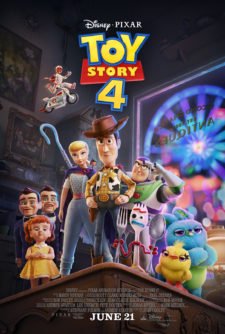
TOY STORY 4
A near-perfect toy box of laughter, loyalty, and self-sacrifice.
Should You Watch It?
This is Pixar doing what Pixar does best: dazzling craftsmanship in service of a story that actually means something. Woody's rescue mission for a nervous spork-toy named Forky becomes a meditation on purpose, loyalty, and what it costs to let someone you love go. Every character gets a real arc, and at least a couple get a genuine transformation — including the film's villain, who is changed by an act of redemptive self-sacrifice.
The cost is modest but real: several scenes with scary ventriloquist dolls and a rigged carnival game push into legitimately tense territory, more intense than earlier Toy Story installments. None of it is gruesome or bloody, but small children may need a hand to hold.
For nearly every family, this is an easy yes — bring tissues for the tears and reassurance for the youngest in the room. Watch it together, and expect to talk about it after.
The Story
NO SPOILERS — WE KEEP THE SURPRISESWoody and the gang now belong to Bonnie, who — nervous about starting kindergarten — builds herself a makeshift toy out of craft-room scraps and a plastic spork: Forky. Forky is convinced he's trash. Woody isn't so sure. When a family RV trip sends Forky bolting for the nearest garbage can, Woody sets off to bring him home — and stumbles into an antique shop holding far more than lost toys.
Is It Any Good?
Four stars means this is Pixar firing on every cylinder — visually and narratively. The animation is another leap forward even by Pixar's own high bar, but it's the storytelling that earns the top marks. Every character, down to minor players, gets a real arc; a couple of them experience genuine epiphanies rather than convenient plot resolutions. The film also finds real laughs alongside its tears, and the emotional beats land because the craft underneath them is so sturdy. It's hard to imagine a tighter script for a story this ambitious.
The Worldview
This is a very strongly Christian-inflected worldview, and it shows up in the film's bones, not just its dialogue. Self-sacrifice for the sake of others sits at the center of the plot, and the film's would-be villain is transformed — not defeated — by that same redemptive act. Loyalty and caring for others are treated as the highest goods a toy (or a person) can practice.
The film also takes purpose seriously. When Forky asks who gave him life, Woody doesn't have a theological answer — but he's certain every toy has one. That's a question the film raises better than it answers, but it raises it honestly, and it points toward something Scripture answers directly.
The story also charts a path toward "growing up" that lands, refreshingly, on monogamous, committed love: independence has its season, but the film's heart settles on faithful relationship rather than permanent autonomy. One character's wardrobe shifts — trousers during a season of self-reliance, a dress again once she reunites with the one she loves — track that same arc; read into it what you will, but the film's own compass points toward togetherness, not separation.
Every toy in this story is fashioned by someone else, for a purpose it did not choose and cannot fully see — a fair echo of Ephesians 2:10: "For we are his workmanship, created in Christ Jesus for good works, which God prepared beforehand, that we should walk in them."
The Content Guide
The specifics — spoilers included by nature — so you can judge for your own family.
Dominant Worldview and Other Worldview Content/Elements
Very strong Christian worldview, with overt self-sacrifice for the benefit of saving others, plus very strong moral elements, including an emphasis on loyalty, caring, relationships, with the villain being transformed by the redemptive self-sacrifice
Foul Language
No foul language, one “I swear,” but meant more as a commitment
Violence
Scary ventriloquist doll characters who turn out to be just trying to help a broken doll, several action cartoon scenes, such as a toy being carried away in a raging torrent by the rain, toy being stepped on, toy falling out of a car, toys fighting, toys in carnival being shot at with ping-pong balls, and lots of action mayhem, but nothing more than a Saturday morning cartoon and nothing gruesome, bloody, or excessively violent
Sex
No sexual content but there are a couple of romantic as well as non-romantic hugs
Nudity
No nudity
Alcohol Use
Quick scene where an older woman goes home and has a glass of wine
Smoking and/or Drug Use and Abuse
No smoking or dug use;
Miscellaneous Immorality
Broken doll wants to remove Woody’s voice box so she can repair her broken voice box, a comment is made about not hiding in a closet, and there is some trickery.
Talk About It
Questions for the drive home, the dinner table, or the youth group.
Forky asks Woody, "Who gave me life?" Woody says he isn't sure, but he knows every toy has a purpose. What do you think God's answer to that question would be?
Ephesians 2:10 · Jeremiah 29:11Woody risks everything for Forky and for Bonnie, and the villain of the story is changed by an act of self-sacrifice, not by force. Where in your own life could love mean giving something up for someone else?
John 15:13Several characters have to decide whether to hold onto independence or commit to someone they love. What does the difference between the two look like in a real relationship?
Ecclesiastes 4:9–10 · Genesis 2:18Toys in this story are loyal to the child who made and loves them. What does loyalty to the people God has placed in your life actually cost you?
Proverbs 17:17The Final Word
Pixar has done it again — a film with real laughs, real tears, and a story built on self-sacrifice, loyalty, and love that actually lasts. It's scary in a few spots for the littlest viewers, but for nearly everyone else, this is an easy family movie night. Worth the trip — use caution with very young children.