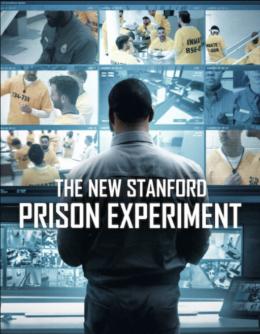
THE NEW STANFORD PRISON EXPERIMENT: Episode 1.1: “THE EXPERIMENT BEGINS”
Power, pressure, and strong foul language collide.
Should You Watch It?
Yes. This new reality television series on Netflix brings back the original Stanford prison experiment from the 1970s. The episode selects thirty people to participate in a 14-day prison experiment to see whether power corrupts. The catch? The participants don’t know what they’re really getting into, and they aren’t told if they will be inmates or guards until they reach the facility.
Three main hosts watch from a room at the prison. Alison Wood Brooks, a behavioral psychologist and professor at Harvard University; Trymaine Lee, a Pulitzer Prize-winning journalist who covers the justice system and power; and Michael Cantrell, a retired federal corrections officer with over thirty years of experience.
The episode includes strong foul language and drug content. As the episode unfolds, different inmates and guards share insights about their daily lives and their take on the experiment and how it proceeds. As intriguing as this episode is, children and young teens should sit this one out, and adults should know exactly what they're signing up for.
The Story
NO SPOILERS — WE KEEP THE SURPRISESThe episode begins by selecting 30 participants from all ages and walks of life. When they arrive at the prison facility, eight participants stand at the front of the group and are assigned the role of guards. The other 22 participants act as inmates. The experiment aims to answer the question, “Does power corrupt?” Very quickly, the thirty participants discover if that’s the case.
Is It Any Good?
Four stars for a fascinating undertaking that challenges viewers to consider whether power would corrupt them if they suddenly found themselves in charge. 30 people from across the nation come together to participate, most eager to embrace the experience while others waste little time testing boundaries.
The diverse group includes a former inmate who brings firsthand experience with life behind bars. This mischievous fifth-grade social studies teacher follows the rules in everyday life, and the CEO of a multimillion-dollar company. Each participant brings a different perspective, adding tension and unpredictability to the experiment.
From the first episode, the results suggest that power can quickly change people. One group of guards takes a stricter approach while another emphasizes teamwork and cooperation. As the trial unfolds, competing leadership styles and unexpected choices challenge the participants’ assumptions, leading to outcomes none of them anticipated.
The experiment also offers older teens a compelling conversation starter about leadership, integrity, and the temptation to abuse authority. After all, power may reveal character, but it can also test it.
The Worldview
At its heart, the episode carries a moral worldview. Most people in the experiment genuinely want to do the right thing, so it works out for everyone else. You’ll also catch a Christian moment when one participant prays as the guards walk him into the prison. That scene stands out because when fear hits, he turns to God first.
Still, the episode slips in a Pagan idea that sounds a lot like karma. One inmate firmly believes, “The more good you do for other people, the more good will come back to you.” Sounds nice, right? But karma says you get exactly what you deserve, and if that held, none of us would stand a chance. The Gospel offers far better news. God gives us grace, a mercy we could never earn on our own.
Parents should know about a few rough spots too. The episode includes foul language, obscenities, drug content, lies, division, and deception. Nobody uses drugs inside the prison, but one photo shows a guy who smokes marijuana from a glass bong, and others show a man who drinks at a bar and shotguns a beer on a lake.
One participant even blows glass for the smoke shop where he works. Even so, the episode gets one big thing right. It honors people who do the right thing and respect authority, even when those leaders don’t seem all that “good.”
The Content Guide
The specifics — spoilers included by nature — so you can judge for your own family.
Content Summary
Dominant Worldview and Other Worldview Content/Elements
A moral and Christian worldview are the driving factors in this episode, with participants respecting authority and praying. Pagan element as one person believes that the more good you do the more good will be done to you
Foul Language
Strong foul language with 45 total profanities, 22 “f” words, 11 “sh” words, two obscenities with one man flicking off the camera in a picture and the word “pissed”
Violence
Light violence as inmates argue with one another
Sex
No sex
Nudity
Natural upper male nudity
Alcohol Use
Photos show a man drinking alcohol
Smoking and/or Drug Use and Abuse
A photo shows a man smoking marijauna and a man’s occupation is a glass blower for a smoke shop;
Miscellaneous Immorality
Decepetion. Descriptions of past criminal activity. Participants lie to get their way and guards are divisive.
Talk About It
Questions for the drive home, the dinner table, or the youth group.
The experiment asks, “Does power corrupt?” Within the first episode, some guards chose to be stern while others chose teamwork. Why do you think people with the same authority use it so differently? How does Jesus define greatness and leadership? Mark 10:42-45
“The more good you do, the more good comes back.” One inmate firmly believes this. It sounds hopeful, but is it fully true? Why does Scripture call us to do good even without a guarantee of reward? Galatians 6:9-10.
The show honors respecting those in authority, even when they aren’t perfect. Where is the line between respectful submission and going along with something wrong? What do these passages together teach about honoring authority and honoring God first? Romans 13:1-7, Acts 5:27-29.
One participant begins praying as they enter the prison. What do you turn to when you’re nervous, powerless, or in an unfamiliar place? What do these verses say about bringing our fears to God? Philippians 4:6-7
The Final Word
THE NEW STANFORD PRISON EXPERIMENT opens with a question most of us think we can answer: “Does power corrupt?” Yet, the first epiode throws a curveball. The guards can’t agree on how to run things, and their split stirs up quarrels among the inmates. Because of the foul language and drug content, older teens should watch with a parent nearby. Afterward, families can talk through how they’d handle that kind of power, what separates a real leader from a bossy one, and why grace beats karma every time. Power never fixes the human heart. Only God can do that.