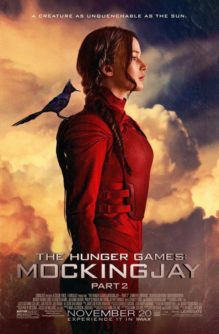
THE HUNGER GAMES: MOCKINGJAY – PART 2
A thrilling, morally serious finale for middle schoolers and up.
Should You Watch It?
This finale offers moments of intense excitement, dynamic character development, and dazzling visuals. Its strongest ideas are also its most worthwhile: liberty matters, totalitarian power must be resisted, faithful love can endure suffering, and the ends do not justify the means.
The movie is less successful in its storytelling. The action sometimes comes in fits and starts, and one major sequence is edited so quickly and unclearly that it becomes a blur. The violence can also be intense and scary, especially for younger viewers.
Still, this is an unusually clean PG-13 action film. It contains no foul language or lewd content, while offering a strong heroine and a moral arc about love triumphing over evil. WORTH THE TRIP — MIDDLE SCHOOL AND UP for families prepared to discuss the violence and assassination plot.
The Story
NO SPOILERS — WE KEEP THE SURPRISESThe rebellion against President Snow’s dictatorship is entering its final stage. Katniss, the symbol of the rebellion, wants to join the assault on the capitol and secretly assassinate Snow.
But the capitol is filled with deadly traps, and Katniss must also face the return of Peeta, whose brainwashing has turned him against her. As the rebels advance, love, loyalty, propaganda, and the cost of freedom are all put to the test.
Is It Any Good?
Four stars means this is an entertaining and artistically impressive film despite some significant storytelling problems. The movie delivers intense excitement, dynamic character development, and dazzling visuals. Its overall arc, in which love triumphs over evil, is strong.
The middle contains many action sequences that do not build the characters or plot. A long sewer sequence involving frightening humanoid creatures is edited and shot so unclearly that viewers can lose sight of what is happening. Even so, the movie remains highly entertaining, and many scenes are extremely exciting.
The Worldview
The film has a strong moral, anti-totalitarian worldview. It supports liberty, representative democracy, enduring and faithful love, truth, sacrifice, repentance, and doing what is right during war. It also promotes trying to minimize civilian casualties and exposes the dangers of propaganda, even when propaganda is being used against great evil.
The movie wisely rejects the idea that the ends justify the means. It also encourages focusing on good things rather than bad things, including painful memories. Katniss’s choice to tell a lie weakens the film’s moral clarity, even though she later confesses it. The story’s redemptive elements remain light and indirect.
The film supports free election of a new president but does not address free elections for a legislature or the establishment of a just judicial system. Without those checks, true liberty remains incomplete. A minor subplot also presents the society’s wealthiest people in a politically correct, leftist way.
God is not mentioned, and the film is shaped for a post-Christian society. Yet its closing emphasis on remembering what is good, true, just, and beautiful may allude to Philippians 4:8: “Whatever is true, whatever is honorable, whatever is just, whatever is pure, whatever is lovely, whatever is commendable… think about these things.”
The Content Guide
The specifics — spoilers included by nature — so you can judge for your own family.
Content Summary
Very strong moral, anti-statist and anti-totalitarian worldview extolling several moral virtues including enduring love, truth, sticking by someone when they’ve been forced or lured into doing wrong things, exposing the dangers of propaganda even when the propaganda might be used to conquer a great evil, working to earn your own food and survival, trying to help civilians and mitigate civilian casualties in a war zone (a Christian principle), doing the right thing during war and other situations, opposition to thinking that “the means justifies the end” (even when fighting evil), and focusing on good things rather than bad things (including bad memories), with strong positive elements supporting at least two American values (liberty and representative democracy), mitigated by a minor liberal, leftist, politically correct subplot in a couple scenes about a society’s wealthiest people (the infamous “one percent”) living in a big urban capitol controlled by an evil dictator who rules the whole society, plus some light redemptive elements of sacrifice, repentance, enduring love; no foul language; some intense and even scary violence includes gun battles, explosions, characters run from a trap involving a huge flood of oil, heroes battle slimy humanoid lizard creatures with no eyes and scary sharp teeth, human bodies fly into objects, one or more people killed by arrows, woman has bruises around her neck and on her tummy; no sex scenes, but two kisses (one in a secular wedding scene) and a second couple is not seen having a wedding, though it is suggested and later they are shown with two children; no nudity; no alcohol use; no smoking; and, light miscellaneous immorality includes heroine lies at one point but confesses later, villain has brainwashed the heroine’s love interest, God isn’t mentioned, and a minor character has been forced to have plastic surgery and tattoos to make her look like a tiger.
Talk About It
Questions for the drive home, the dinner table, or the youth group.
The film presents liberty and representative democracy as alternatives to dictatorship. What protections does a just government need so that one leader cannot control everything?
Isaiah 33:22 · Romans 13:1–4The story warns that propaganda can be dangerous even when it is used against evil. How can we pursue truth when we strongly want a particular outcome?
Ephesians 4:25 · Philippians 4:8Katniss’s lie is eventually confessed. What is the difference between hiding the truth, admitting wrong, and making things right?
Proverbs 28:13 · James 5:16The film emphasizes enduring love through suffering. What does faithful love look like when someone has been harmed or changed by difficult circumstances?
1 Corinthians 13:4–7 · Colossians 3:12–14The Final Word
This is a thrilling, visually impressive finale with a strong moral core, a courageous heroine, and no foul language or lewd content. Its intense violence and assassination plot call for parental discernment, but its themes of liberty, truth, and enduring love give families much to discuss. WORTH THE TRIP — MIDDLE SCHOOL AND UP.