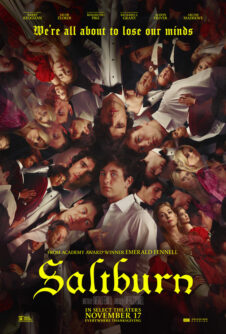
SALTBURN
Gorgeously made, morally poisonous — a beautiful film to walk away from.
Should You Watch It?
Let's be honest about both halves of this. On pure craft, Saltburn is a genuine achievement — one of the best-composed films of its year, anchored by a career-best performance from Barry Keoghan and stunning cinematography. If technique were the only measure, it would earn its praise.
But technique isn't the only measure, and here the technique is in the service of something rotten. This is a story that revels in its characters' vices with grotesque candor — sexual promiscuity, incest, murder, an ocean of profanity — and then lets its protagonist manipulate and kill his way to a fortune with no repercussions and no repentance. The camera never judges. Neither does the script.
So our answer is plain. However beautifully it's shot, this is a film built to corrode, and it aims that corrosion squarely at the thoughtful viewer. Skip it, and don't feel you're missing anything your soul needs.
The Story
NO SPOILERS — WE KEEP THE SURPRISESOliver is an Oxford student whose fascination with his charismatic classmate, Felix Catton, curdles into obsession. When Felix invites him to spend the summer at Saltburn, the family's grand manor, Oliver steps into a world of wealth and appetite unlike anything he's known.
He sees that world as a ladder. And once inside, he begins to play the Catton family against one another — a quiet, patient campaign whose true shape only becomes clear later. That's as far as we'll take you.
Is It Any Good?
Three stars, and they belong to the filmmaking, not the film's heart. Saltburn is a masterclass in visual composition — its mise-en-scène ranks among the year's finest, and Oscar-winning cinematographer Linus Sandgren delivers some of his best work. Barry Keoghan is extraordinary in the lead.
The storytelling doesn't keep pace with the craft. Writer-director Emerald Fennell's script is too rushed to tease out the fine layers a strong psychological thriller needs. Oliver's scheme is revealed hastily and awkwardly in the final minutes, with too little foreshadowing to let the twist land with real force. What could have been a slow, coiling dread instead lurches to its reveal. The result is beautiful, accomplished, and structurally undercooked — a film that impresses the eye more than it satisfies the mind.
The Worldview
Saltburn believes almost nothing worth believing. Its worldview is aggressively hedonistic and self-centered — a pagan vision in which appetite is the only law and other people are merely means to an end. Oliver manipulates, deceives, and finally murders his way into a fortune, and the film grants him exactly no repercussions and no repentance. The supporting characters are scarcely better; the whole ensemble seems designed to prove that everyone is for sale.
That is the deepest problem here. A story can show sin honestly without approving it, but this one removes the very idea of consequence. Evil succeeds, and the camera admires the success. There is no moral floor beneath these characters, and the film seems to prefer it that way.
The homosexual content and behavior are strong and woven throughout, alongside references to polyamory and incest — all presented as part of the world's glamorous, unbothered decadence.
Underneath the manor's beauty runs a longing the film can name but never satisfy: the ache to belong, to be let inside a golden life. Scripture measures that hunger differently. "For what does it profit a man to gain the whole world and forfeit his soul?" (Mark 8:36). Oliver gains the house. The film never asks what he lost.
The Content Guide
The specifics — spoilers included by nature — so you can judge for your own family.
Dominant Worldview and Other Worldview Content/Elements
Very strong hedonistic, self-centered, immoral, pagan worldview where the protagonist manipulates, tricks and even murders his way into a substantial fortune, with no repercussions or repentance, and the morals of the supporting characters aren’t much better, plus strong homosexual content and behavior
Foul Language
At least 65 “f” words, eight other obscenities, seven strong profanities using the name of Jesus Christ, and six light profanities
Violence
Two scenes of dead bodies being found, one of which involves blood, and a man takes a character off life support to let her die
Sex
Very strong sexual content includes frequent references to sexual activity, including homosexuality, polyamory, and incest, three scenes of unmarried sexual contact (one is homosexual), and two scenes of male auto-
Nudity
Full male nudity
Alcohol Use
Frequent drinking at parties, bars and meals
Smoking and/or Drug Use and Abuse
Cigarette smoking and cocaine use;
Miscellaneous Immorality
Manipulation, deception, and hurting people to benefit oneself materially without any negative repercussions.
Talk About It
Questions for the drive home, the dinner table, or the youth group.
Oliver gains a fortune and loses everything that matters — though the film never says so. What does Jesus say a person truly trades away when he sells his soul for the world?
Mark 8:36–37 · Luke 12:15This story shows evil succeeding with no consequence. Does that match how the world actually works, and how does Scripture describe the end of the wicked who prosper for a season?
Psalm 73:16–20 · Galatians 6:7The film is beautifully made in service of an ugly heart. How do we hold both truths at once — admiring craft while refusing what it celebrates?
Philippians 4:8Oliver's whole scheme is built on manipulation and deception dressed up as friendship. What does real love look like by contrast, and how would you know the difference?
1 Corinthians 13:4–7 · Romans 12:9The Final Word
Some films are easy to dismiss because they're bad. This one is harder, because it isn't — it's gorgeously made and genuinely accomplished, and it points all that skill at something corrosive. That's exactly why our answer is the one we started with: skip it. For a movie night that won't cost you anything, try our family-friendly picks instead.