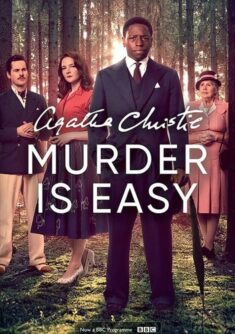
MURDER IS EASY (2024)
A handsome Christie mystery that never quite adds up.
Should You Watch It?
Here's the honest picture. This two-part BritBox adaptation of Agatha Christie is a fine production with serviceable performances all around, and it's remarkably clean — no foul language, no extreme violence, no lewdness. At its heart is a principled man risking much to stop a killer, which is a story worth telling.
But the telling wobbles. Too many plot elements are simply odd and left unexplained — a recurring dream sequence that goes nowhere, a killer whose identity never quite makes sense, villagers who never question a stranger doing the police's work. It's a strange, lackluster viewing experience that doesn't always hang together.
So this is a "wait and see." There's nothing here to grieve a conscience, and fans of vintage mysteries may enjoy the atmosphere. But it's a confusing letdown more than a satisfying evening — worth a look only if the setting alone is enough for you.
The Story
NO SPOILERS — WE KEEP THE SURPRISESIt's 1954. Luke Fitzwilliam, a Nigerian diplomat and landowner far from home, shares a train compartment with an elderly woman named Mrs. Pinkerton. She confides that a string of suspicious deaths has struck her sleepy village, Wychwood Under Ashe — and she's on her way to Scotland Yard to name the murderer.
She never arrives.
Feeling responsible, Luke sets out to finish what she started. In Wychwood he finds an unexpected ally in Brigid, a young woman engaged to the town's leading man. Together they start pulling at threads in a quiet village where murder, it seems, comes all too easily.
Is It Any Good?
Two stars, and here's what they mean: the craft is there, but the storytelling isn't. This is a fine production with capable performances on every side, and it looks the part of a proper period mystery. What it lacks is coherence.
The film keeps introducing elements it never accounts for. Luke's recurring dream — lost in the woods, holding and dropping an African totem that bursts into flame — is left almost totally unexplained, leaving the audience puzzled while the hero seems unbothered. The identity of the killer doesn't quite add up either. And the villagers' easy cooperation with a stranger asking pointed questions strains belief. The result is atmospheric but strange and lackluster — a handsome package around a story that never satisfies.
The Worldview
For all its flaws, this is a story with a strong moral spine. Its hero risks himself to save lives by unmasking a serial killer — a principled, determined man valiant for the truth. The two central women, Mrs. Pinkerton and Brigid, share that same commitment to what's right. The pursuit of truth to protect the innocent is the film's beating heart, and Scripture holds it dear.
The problems here are less philosophical than cinematic, but a couple are worth naming. A recurring dream leans on a pagan African totem, imagery that sits oddly against the story and never pays off. And the ending trades the novel's resolution for a strand of anachronistic feminism — a character declaring "It's 1954. Women can do whatever they want to" before wandering off to nothing in particular. It reads as imposed rather than earned, and it detracts from the drama.
The production also recasts Christie's British detective as a Nigerian diplomat. We found the change distracting, mostly because none of the elements it introduces end up mattering to the plot; weigh that as you will.
Underneath it all is a good longing: that hidden evil be dragged into the light and the innocent spared. Scripture makes the same promise — "For nothing is hidden that will not be made manifest" (Luke 8:17).
The Content Guide
The specifics — spoilers included by nature — so you can judge for your own family.
Dominant Worldview and Other Worldview Content/Elements
Strong moral worldview where a young man seeks to save the lives of many people by finding the identity of a serial killer, the protagonist is a principled and determined man seeking the truth, as are the lead female characters, but the movie inserts some politically correct anachronistic feminism, which detracts from the story and there are references to a pagan African totem in a recurring dream sequence
Foul Language
No foul language
Violence
A man is seen running with a totem in hand through a forest in what appears to be a dream when he drops the item, and it catches fire on the ground, the body of an elderly woman is shown with a bit of blood on her right temple, a young man is shown several times falling to his death with impact and some blood flowing from his mouth, several serial killings via blunt force trauma and poisoning are briefly shown, a man is found with a bloody wound on the right side of his neck, and the supposed murder weapon, a tree branch, is found with blood on it next to the victim
Sex
A young man caresses a young woman alone in a room, kissing her neck, and seems on the edge of helping her disrobe when they’re interrupted
Nudity
No nudity
Alcohol Use
Several instances of social drinking
Smoking and/or Drug Use and Abuse
No smoking, but a killer uses drugs to subdue murder victims
Miscellaneous Immorality
A medical doctor is deeply devoted to eugenics and keeps several books on the subject in his office.
Talk About It
Questions for the drive home, the dinner table, or the youth group.
Luke feels responsible to finish the work of a woman he barely knew, at real cost to himself. When does a duty to protect others become our own to carry?
Proverbs 24:11–12 · Galatians 6:2The whole story turns on bringing a hidden killer into the light. Why does Scripture insist that nothing stays secret forever, and what comfort — or warning — is in that?
Luke 8:17 · Ecclesiastes 12:14A doctor in the story quietly devotes himself to eugenics, treating some lives as worth less than others. How does the Bible's view of every person made in God's image confront that?
Genesis 1:27 · Psalm 139:13–16The film ends with a character declaring she can do "whatever she wants." Where does true freedom actually come from, and how is it different from doing whatever we please?
John 8:32 · Galatians 5:13The Final Word
This one is clean, well-made, and oddly hollow — a period mystery that dresses beautifully and then loses the thread. There's a genuine moral heart here, but too much of the story never adds up. So our answer is wait and see: sample it if the setting draws you, but don't expect it to satisfy. Craving something more rewarding for the evening? Try our latest family-friendly picks.