UNSUNG HERO
A family's leap of faith, told with rare sincerity and heart.
Should You See It?
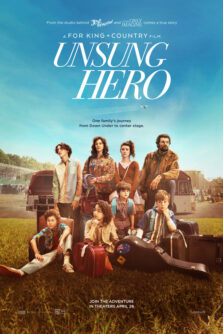
Yes — and gladly. UNSUNG HERO tells the true story of the Smallbone family, uprooted from Australia and remade in Nashville, with a script and cast strong enough to make a familiar underdog arc feel fresh. It earns its four stars honestly: tight pacing, convincing performances, and a story that trusts its own sincerity instead of straining for it.
What you get for your two hours is a portrait of a family under real pressure — financial, marital, spiritual — choosing faith and each other again and again. The worldview is strongly, unapologetically Christian: prayer, sacrificial love, and courage carry the story rather than decorate it.
The only caution worth naming is a brief, difficult childbirth scene — no blood, but tense — that may be too much for the youngest viewers. Everyone else: take the whole family.
The Story
NO SPOILERS — WE KEEP THE SURPRISESDavid Smallbone has just lost big promoting a failed music tour. Convinced a fresh start in Nashville might save his family's future, he uproots his wife, Helen, and their children from Australia to America. Odd jobs and a local church keep them afloat while David chases work in the music industry — until the people closest to him start pointing at the talent he's overlooked all along: the one living under his own roof.
Is It Any Good?
Four stars means this one does almost everything right, and it does. The film moves with unusual discipline for its genre — little wasted time, a nearly two-hour runtime that never drags. Joel Smallbone, playing his own father, gives a genuinely convincing lead performance, and the rest of the family cast each find a distinct, believable place in the story. The music fits the family's highs and lows without ever feeling like a soundtrack cue.
What elevates it further is restraint: a story this earnest about faith and family could easily tip into preachiness, and this one doesn't. The struggles — a marriage under strain, children caught in upheaval, a father's fear of failure — feel real rather than staged, which is what makes the eventual triumph land.
The Worldview
This is a strongly, deliberately Christian film, and it wears that faith well. The Smallbone family prays to Jesus for guidance and provision throughout, and their songwriting becomes an extension of that faith rather than a separate thread. Sacrificial love, honor, and courage aren't stated themes — they're what the characters actually do under pressure, scene after scene.
A few moments carry real spiritual weight. Helen's "burn the ships" speech to her children reframes their hardship as a mission rather than a misfortune. David's father repeats a line from Kipling's "If" — "if you can dream and not make dreams your master" — as a running reminder that God's plans outsize our own ambitions. And a line late in the film distills the whole story: "Your family... they're not in the way. They are the way."
The one moral wrinkle is minor: some lying about the character of Santa Claus, noted in the content guide below. It's a small thing in an otherwise clean, edifying picture.
At its heart, this is a story about trusting that provision comes from faithfulness, not striving — a truth Scripture states plainly: "But seek first the kingdom of God and his righteousness, and all these things will be added to you" (Matthew 6:33).
The Content Guide
The specifics — spoilers included by nature — so you can judge for your own family.
Very strong Christian, biblical, moral worldview with characters manifesting sacrificial love, faith, honor, and courage through various trials, with many prayers to Jesus and references to God and Jesus
No foul language
A woman has some complications in childbirth (hard labor is shown briefly with no blood, and the character is shown later recovering), a woman slaps a man in a tense argument, and a man slams a telephone against a countertop
No sex
No nudity
No alcohol use
No smoking or drugs;
Some lying regarding the character of Santa Claus.
Talk About It
Questions for the drive home, the dinner table, or the youth group.
Helen tells her children they're on a "dangerous mission" and must "burn the ships." What would it look like for your family to commit fully to a hard calling instead of leaving an escape route?
Joshua 24:15David's father says, "Your family... they're not in the way. They are the way." Do you tend to treat your family as an obstacle to your goals or as the point of them?
Ephesians 5:25–28 · Proverbs 31:28The Kipling line — "if you can dream and not make dreams your master" — gets repeated throughout the film. How do you tell the difference between a God-given dream and a dream that's started ruling you?
Matthew 6:33 · Proverbs 16:9Rebecca St. James's character says she sings so it can "help other people find what God's given me and my family." What has God given your family that's meant to be shared, not kept?
1 Peter 4:10The Final Word
This is a rare family film that's both well made and wholly clean — four stars for craft, and barely a caution worth naming. It's the kind of true story that earns its inspiration instead of demanding it. Our answer: worth the trip. Gather the family, maybe skip the popcorn during the birth scene, and go.