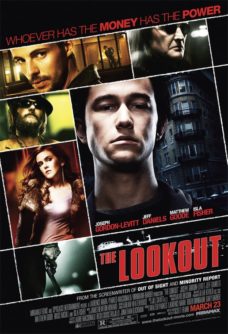
THE LOOKOUT
A superb, redemptive thriller for discerning adults.
Should You Watch It?
Here is the decision plainly: The Lookout is an exceptionally well-written, well-directed thriller with a powerful central performance. Its story takes guilt, repentance, penance, forgiveness, and reconciliation seriously. Brief allusions to God and Jesus add a redemptive dimension.
That merit comes at a real cost. The movie contains about 49 obscenities, including many “f” words, seven strong profanities, sexual content, violence, alcohol and drunkenness, smoking, and references to a meth lab. Its Christian elements are not strong enough to offset that material for families.
If you are an adult who can thoughtfully engage those concerns, The Lookout is worth watching for its craft and moral arc. For children and young teens, choose something else.
The Story
NO SPOILERS — WE KEEP THE SURPRISESChris Pratt is a popular rich kid whose life changes after a terrible road accident leaves him struggling with memory problems and dependent on others. Now working as a night janitor at a bank, Chris meets Gary, an older former classmate who offers friendship and introduces him to Luvlee Lemons.
Gary has an ulterior motive: he wants Chris’s help robbing the bank. When the plan takes a violent turn, Chris must draw on his memory tricks and newfound confidence to face what comes next.
Is It Any Good?
Four stars means this is a top-quality thriller, and the source’s praise is emphatic. The Lookout has a clever plot, a compelling character arc, taut direction, and a classic circular structure in which early situations and references resonate brilliantly later.
Joseph Gordon-Levitt is superb as Chris Pratt, and his performance holds the movie together. The result is a powerful combination of suspense, emotion, and carefully shaped storytelling. Its main weakness is not craft but content: very strong foul language, some sexual content, and violence limit its audience.
The Worldview
The Lookout presents a light Christian worldview with strong moral elements. Its central movement is from guilt toward repentance, penance, forgiveness, and reconciliation. The film also includes brief positive allusions to God and Jesus and ends on a redemptive note.
At the same time, the story involves strong immoral pagan content and serious wrongdoing, including deceit, robbery, kidnapping, and reckless driving. The Christian perspective remains brief rather than fully developed, so the film’s moral arc is stronger than its explicit theology.
The film’s deepest concern is whether a person marked by guilt can face tragedy, accept responsibility, and find forgiveness. Scripture gives that longing its clearest answer: “If we confess our sins, he is faithful and just to forgive us our sins and to cleanse us from all unrighteousness” (1 John 1:9).
The Content Guide
The specifics — spoilers included by nature — so you can judge for your own family.
Content Summary
Light Christian worldview with some strong moral elements and brief allusions to God and Jesus, marred by strong immoral pagan content, but the movie ends on a redemptive note of repentance, forgiveness and reconciliation; about 49 obscenities (including many "f" words), seven strong profanities and two light profanities; strong action violence with a little blood includes strong implied car crash, people shot to death, shots of a fatal accident scene, bank robbers threaten night janitor who has second thoughts about helping them, man punched in stomach, and life of blind man threatened; implied fornication, passionate kissing and a few crude sexual references; partial rear female nudity when woman's lying on bed and upper and rear male nudity; alcohol use and drunkenness; smoking and references to working on a meth. lab in the past; and, lying, deceit, robbery, kidnapping, reckless driving, and father and son are slightly estranged but there is reconciliation at the end.
Talk About It
Questions for the drive home, the dinner table, or the youth group.
Chris’s choices lead to guilt and lasting consequences. What does genuine repentance look like after we have harmed others?
2 Corinthians 7:10 · Psalm 51The story moves toward forgiveness and reconciliation. How are forgiveness and reconciliation connected, and where might they differ?
Ephesians 4:32 · Colossians 3:13Gary uses friendship to pursue selfish and criminal ends. What does Scripture say about choosing wise friends and recognizing destructive influence?
Proverbs 13:20 · 1 Corinthians 15:33The film includes brief allusions to God and Jesus but does not develop an explicit Christian perspective. What does the gospel say is the true source of forgiveness?
1 John 1:9 · Ephesians 1:7The Final Word
The Lookout is superbly made and emotionally serious, with a redemptive arc worth considering. But its strong profanity, sexual content, violence, and other adult material make it unsuitable for children and young teens. For discerning adults, the answer is WORTH THE TRIP — ADULTS ONLY. For family viewing, see.