
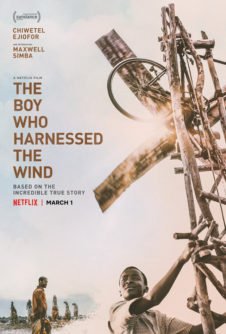
THE BOY WHO HARNESSED THE WIND
A Malawian teen's ingenuity turns famine into a redemptive family story.
Should You Watch It?
Yes — and gladly. This is the true story of William Kamkwamba, a Malawian teenager whose homemade windmill saved his village from starvation, and it's told with excellent performances and a redemptive father-son story running through its center. It's the kind of movie that leaves you inspired rather than merely entertained.
It does ask something of younger viewers. A group of masked, stilt-walking dancers called the Gule Wamkulu appear at a funeral to represent "the spirits," and the film never fully explains who or what they are — their otherness alone may unsettle small children. There's also brief political violence when a chief is beaten by a president's men, and a mother's line dismissing prayer for rain in favor of "education and science" that parents will want to talk through.
None of that outweighs what the film gets right. Bring older children and adults; let the littlest ones sit this one out.
The Story
NO SPOILERS — WE KEEP THE SURPRISESWilliam Kamkwamba is a bright, curious teenager in the Malawian village of Wimbe, sent home from school when his family can't cover the fees. A famine is closing in — bad rains, deforested land, political mismanagement — and his father is too afraid to spend what little money the family has. Then William gets his hands on a library book about energy, and an idea takes hold: a windmill, built from junkyard parts, that could pump water and save the village. He needs just two things to build it — and convincing his family to give them up won't be easy.
Is It Any Good?
Four stars means this is about as good as it gets — and the source material backs that up. The cinematography and acting are called excellent, and the father-son story is described as woven skillfully throughout the plot rather than bolted on. What makes the film work, by this account, isn't spectacle; it's the patient build of a family under strain and a boy whose stubborn hope pays off. Inspiring and compelling are the words used, and they hold up: this is a well-crafted piece of storytelling, not just an admirable message with a camera pointed at it.
The Worldview
This film exalts something Scripture exalts too: a father and son finding their way back to each other, and a community's survival built on sacrifice, patience, and hard-won wisdom. The family's meals open in prayer, in Jesus' name, and the story's moral center is unmistakably Christian.
It also sits inside a real, textured culture that doesn't always share that center. William's mother stops his father from praying for rain, saying she no longer believes in it "like their ancestors" — a humanist note suggesting that education and science alone are what's needed. A Muslim funeral appears briefly. And the Gule Wamkulu, masked stilt dancers who show up at a Christian funeral to represent "the spirits," are left deliberately unexplained — the film doesn't clarify whether they're folk custom or something more. None of these moments overwhelm the story's Christian, moral, and even pro-capitalist backbone, but they're there, and discerning viewers should know it going in.
At its heart, this is a story about a family learning to trust each other again after fear nearly broke them — which is not so far from the father who ran to meet his returning son while he was still a long way off. "Bring quickly the best robe, and put it on him... for this my son was dead, and is alive again" (Luke 15:22–24).
The Content Guide
The specifics — spoilers included by nature — so you can judge for your own family.
Dominant Worldview and Other Worldview Content/Elements
Strong Christian, moral, pro-capitalist worldview mixed with some non-Christian elements, including a humanist element where woman stops a man for praying to God because she believes only education and science are necessary plus a brief Muslim funeral and there’s a dance group dancing to “the spirits” during a Christian funeral
Foul Language
Three light obscenities
Violence
Light mild violence due to political unrest
Sex
No sexual content
Nudity
Upper male nudity during a brief bath
Alcohol Use
No alcohol use
Smoking and/or Drug Use and Abuse
No smoking or drugs;
Miscellaneous Immorality
Lying, gambling reference, blackmail, eloping.
Talk About It
Questions for the drive home, the dinner table, or the youth group.
William's father is too afraid to give up what little he has for his son's future, and it takes the whole story for the family to find its way back to trust. What does real reconciliation between a parent and child look like?
Luke 15:20–24 · Malachi 4:6William's mother stops his father from praying for rain, trusting instead in education and effort alone. How do prayer and hard work fit together in a Christian life — is it one or the other?
James 2:14–17 · Proverbs 3:5–6The Gule Wamkulu dancers represent "the spirits" at a Christian funeral, and the film never quite explains what that means. How should Christians think about cultural traditions that mix in ways we don't fully understand?
1 Corinthians 10:23 · Colossians 2:8William uses a library book, junkyard scraps, and stubborn persistence to save his village. What does his story suggest about how God expects us to use the gifts and resources we're given?
Matthew 25:14–30 · 1 Peter 4:10The Final Word
This is a true story worth your time and your family's attention — a boy's ingenuity, a father and son finding their way back to each other, and a village pulled back from the edge of starvation. There are a few things to talk through afterward, but nothing that should keep older children and adults away. Worth the trip — older children and adults.