NUTCRACKER IN 3D
A creative Christmas fantasy too dark for younger children.
Should You Watch It?
You may find much to admire in this modern retelling of Tchaikovsky’s famous Christmas ballet. The creative vision is enormous, the production values are impressive, and the child actors give top-notch performances. The story also reaches a positive resolution.
But the film’s darkness works against its Christmas setting and younger audience. The narrative becomes structurally awkward, contrived, tedious, and somewhat self-important. Tim Rice’s lyrics fall short, the 3D adds little, and the harsh voice given to the Nutcracker under the spell distances and confuses the audience.
The film has enough imagination and strong acting to interest older children and adults, but younger children may find it too dark. For your family, choose it only if your children are ready for its frightening imagery and confusing worldview messages.
The Story
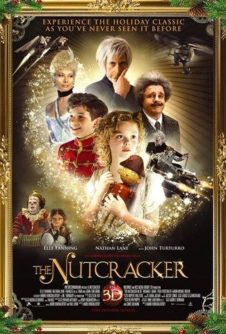
NO SPOILERS — WE KEEP THE SURPRISESIn 1920s Vienna, young Mary receives a wooden nutcracker from her imaginative Uncle Albert, who also gives her a massive dollhouse filled with tiny animated toys. When Mary enters a world of dreams, the Nutcracker comes to life and welcomes her into a magical kingdom.
There she meets his friends, learns about the Rat King’s cruel rule, and discovers that the Nutcracker is really an enchanted prince. As Mary and her friends prepare to fight back, her brother Max is drawn toward the Rat King and his dark world.
Is It Any Good?
Three stars means this is an imaginative, uneven film with real strengths. The overall creative vision is impressive, the production values are strong, and the child actors are completely top notch. The real boy’s performance as the Nutcracker is warm and endearing.
The film falters in its execution. The story becomes structurally awkward, cliché, contrived, tedious, and a little self-important. Tim Rice’s lyrics do not work consistently, and the 3D serves no real purpose because most of the movie barely uses it. The Nutcracker’s contrasting voices also distance and confuse the audience.
The Worldview
The film presents a magical world shaped by dreams, imagination, spells, and belief. Some of its moral elements and Christmas references are positive, but witchcraft is part of the story, and the Rat Queen casts spells. The song “It’s All Relative” appears to promote situational ethics before retracting that message with a refrain at the end.
The movie also includes moral relativism, the statement that reality is an illusion, and partially negative parental figures. These elements are resolved by the end, but they can still confuse younger viewers. The film’s darkness, rather than its Christmas setting, becomes one of its defining qualities.
The story’s emphasis on belief and light can point toward a deeper truth, even though the film expresses that truth through fantasy. Scripture says, “The light shines in the darkness, and the darkness has not overcome it” (John 1:5).
The Content Guide
The specifics — spoilers included by nature — so you can judge for your own family.
Content Summary
Light Romantic, magical worldview with some witchcraft casting spells and some lyrics carrying confusing worldview messages such as the song, “It’s All Relative,” which seems to perpetuate situational ethics, only to be retracted at end of the movie with a refrain, plus some moral elements and references to Christmas; one obscenity and one light profanity; light violence includes man cracks open a walnut with another mans forehead, Rat Queen bites her son on the ear, Rat King snaps off head of living toy drummer boy and throws it around, Ratman gets fist in face, another gets hit in face with a shovel, and fighting between soldiers; no sexual content; no nudity; Housekeeper shown intoxicated, but no drinking shown; smoking cigars; and, kidnapping, moral relativism, man says reality is an illusion, and partially negative parental figures, though resolved in the end.
Talk About It
Questions for the drive home, the dinner table, or the youth group.
The film presents belief and imagination as powerful forces. How can you pursue wonder while also testing what you believe against God’s truth?
Romans 12:2 · 1 Thessalonians 5:21The song “It’s All Relative” raises questions about whether right and wrong depend on the situation. Where does Scripture locate the standard for truth and goodness?
John 17:17 · Isaiah 5:20The story contrasts darkness with the possibility of light. What does Jesus mean when He says, “I am the light of the world”?
John 8:12 · John 1:5The film includes strained and partially negative parental figures. What responsibilities does Scripture give parents toward their children?
Deuteronomy 6:6–7 · Ephesians 6:4The Final Word
This imaginative Christmas fantasy has strong child performances, impressive production values, and a positive resolution. But its darkness, violence, witchcraft, and confusing moral messages make it a better choice for older children and adults than for young children. Our answer is WORTH THE TRIP — OLDER CHILDREN AND UP.