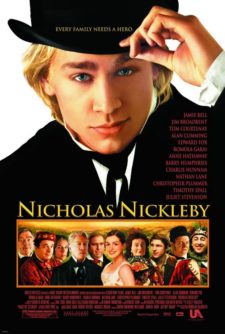
NICHOLAS NICKLEBY
An entertaining Dickens adaptation best suited to older children and adults.
Should You Watch It?
This is a very entertaining adaptation of Charles Dickens’ story about a young man protecting his family from cruel and selfish people. Its strongest elements are its clear distinction between good and evil, its social commentary, its lively supporting cast, and its ultimately redemptive ending.
The film also includes questionable elements that could have been left out, especially since the story’s moral clarity and happy ending might otherwise have made it suitable for younger viewers. Parents should use discernment with elementary-age children, while older children and adults are more likely to appreciate the drama.
If your family enjoys serious literary adaptations and can handle the darker material, this is worth watching; for younger children, choose something gentler.
The Story
NO SPOILERS — WE KEEP THE SURPRISESAfter Nicholas Nickleby’s father dies, Nicholas must care for his widowed mother and younger sister. The family travels to London seeking help from Nicholas’ wealthy uncle, Ralph, only to discover that his generosity is nowhere to be found.
Nicholas is sent to work at a cruel boarding school for unwanted boys. There, he befriends the mistreated Smike. After standing up to the school’s vicious master, Nicholas escapes with Smike and begins a journey to reunite his family and confront the forces threatening them.
Is It Any Good?
Three stars means this is a very entertaining film with real strengths, though it falls short of greatness. The major supporting performances are superb, and the younger performers are strong overall. The lighting, sets, and cinematography are wonderful, especially the contrast between bleak, dim interiors and the sunlit English countryside.
The lead performance is less powerful than the work surrounding it, partly because Nicholas is written as relentlessly moral and almost too good to be true. The villains sometimes play their roles for laughs, softening characters otherwise drawn as purely evil. The adaptation also edits and combines parts of Dickens’ novel, but remains a satisfying result.
The Worldview
The film presents a strong humanist moral worldview. Its central conflict clearly separates good from evil, and good ultimately triumphs over cruelty, selfishness, and exploitation. Nicholas is completely moral, while the villains represent a view of humanity in which moral choices are made without profound faith in God.
There is little overt Christianity. A background figure sings about the glory of God near the end, but none of the major characters expresses profound faith. The film does, however, affirm family loyalty, compassion for the vulnerable, resistance to injustice, and the possibility of redemption.
The film also imposes a modern theatrical dynamic through its casting of Barry Humphries as Mrs. Crummles opposite Nathan Lane’s effeminate version of Crummles. This is an unnecessary and inappropriate departure from Dickens’ own social commentary.
The story’s belief that evil should be answered by goodness aligns with Scripture: “Do not be overcome by evil, but overcome evil with good” (Romans 12:21).
The Content Guide
The specifics — spoilers included by nature — so you can judge for your own family.
Content Summary
Very strong moral worldview and little overt Christianity, except in a song, but good does prevail as well as suggestion of a theatrical producer as being homosexually inclined; one obscenity and 12 “Oh my God”-type profanities; brief, non-gory representation of man hanging himself; no sex; upper male nudity and baby’s genitalia shown; some drinking; and, miscellaneous immorality such as kidnapping.
Talk About It
Questions for the drive home, the dinner table, or the youth group.
Nicholas responds to cruelty by protecting someone weaker than himself. What does Scripture teach about defending the vulnerable and standing against injustice?
Proverbs 31:8–9 · Micah 6:8Nicholas’ family suffers because of another person’s selfishness, but he continues working to care for them. What does faithful responsibility look like in your own family?
1 Timothy 5:8 · Galatians 6:2The story sharply contrasts good and evil. How can Christians resist evil without becoming hateful or vengeful themselves?
Romans 12:17–21 · 1 Peter 3:9The film ends on a redemptive note. What is the difference between a happy resolution and the deeper redemption God offers?
Ephesians 1:7 · 2 Corinthians 5:17The Final Word
NICHOLAS NICKLEBY is a very entertaining Dickens adaptation with strong moral themes, beautiful period filmmaking, and excellent supporting performances. Its questionable elements call for parents’ discernment with younger children. For older children and adults, it is WORTH THE TRIP — OLDER CHILDREN AND ADULTS.