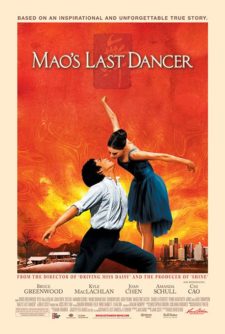
MAO’S LAST DANCER
A beautiful, inspiring ballet drama about freedom found in America.
Should You Watch It?
MAO'S LAST DANCER is a rare film that combines beautiful artistry with a powerful human story. The ballet sequences are terrific, and the drama has strong turning points as Li Cunxin discovers freedom, prosperity, love, and a life beyond the control he knew in Communist China.
The film openly condemns Communist oppression and celebrates freedom, republican democracy, capitalism, and the rule of law. It also carries a modest content concern: some ballet dancing includes upper male nudity, very skimpy costumes, and suggestive movement. There is passionate kissing, light foul language, and one joke about passing gas.
For older children and adults, this is a marvelous, highly recommended movie. WORTH THE TRIP for families whose children are ready for its mature artistic and historical themes.
The Story
NO SPOILERS — WE KEEP THE SURPRISESLi Cunxin grows up in a poor village in China before Communist officials take him from his family to train at a ballet school in Beijing. His instructor, Teacher Chan, helps him become an exceptional dancer.
Years later, Li is chosen to travel to Houston as part of an international arts exchange. In America, he begins questioning what he was taught about freedom and prosperity. When Chinese officials try to control his future, Li must decide where he belongs.
Is It Any Good?
Four stars means this is an outstanding film, and the source review strongly praises both its craft and its story. MAO'S LAST DANCER is extremely beautiful and artistic, with terrific ballet sequences and a well-told, powerful drama.
Its greatest strength is the way the turning points make Li's personal journey compelling. The movie is fascinating rather than merely “important,” and its inspiring story gives the artistry real emotional weight.
The Worldview
The film presents Communist China as oppressive and deceptive, while portraying the United States as a place of freedom and prosperity. Li has been taught that Communism has created an ideal society and that America is dark and impoverished. His experience challenges that teaching as he discovers that he need not fear insulting the president, being watched, or being controlled.
The movie strongly affirms freedom, republican democracy, capitalism, and the rule of law. It also condemns international socialism, totalitarian government, lying, and political manipulation. Its perspective is explicitly pro-American and anti-Communist, but it contains no overt Christian content.
The film's central longing is freedom: the freedom to speak, choose, love, and live without coercion. Scripture says, “For freedom Christ has set us free” (Galatians 5:1), while also pointing beyond political freedom to freedom from sin.
The Content Guide
The specifics — spoilers included by nature — so you can judge for your own family.
Content Summary
Very strong moral, pro-American, pro-capitalist, anti-communist, pro-freedom, and pro rule of law worldview with no overt Christian content about the oppression in Communist China versus freedom in the United States in the 1980s; six light obscenities and two light profanities, plus a young boy breaks wind as a joke; grueling physical training for the ballet with people getting sprains and pains, Communist officials threaten people, and man has repeated nightmare of mother being shot by Communist firing squad; no sex scenes but some passionate kissing, woman talks about being a virgin and never having sexual relations, and provocative dancing; upper male nudity; minor alcohol use; no smoking or drugs; and, Communist oppression, lying, totalitarian government, cheating, Communist officials are blatantly deceptive, and possible homosexual character but never shown.
Talk About It
Questions for the drive home, the dinner table, or the youth group.
Li learns to question what he has been taught. How can we pursue truth when authority figures or institutions ask us to believe something false?
John 8:31–32 · Acts 17:11The film contrasts control with freedom. What kinds of freedom are good gifts, and how should freedom be used responsibly?
Galatians 5:1, 13Teacher Chan helps Li develop his gifts despite opposition. Who has helped you grow, and how can you encourage someone else's abilities?
1 Peter 4:10 · Philippians 2:3–4Li's story involves leaving home and facing uncertainty. When have you needed courage to follow what is right?
Joshua 1:9 · Proverbs 3:5–6The Final Word
Beautiful, dramatic, and deeply inspiring, MAO'S LAST DANCER celebrates freedom through one dancer's extraordinary journey. Its modest content concerns call for parents' judgment, but older children and adults have much to gain from its artistry and moral seriousness. WORTH THE TRIP.