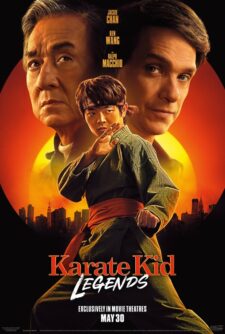
KARATE KID: LEGENDS
Honor prevails, even when the plot gets crowded.
Should You Watch It?
This is a legacy sequel that mostly earns its keep. Jackie Chan returns as a wise kung fu teacher, Ralph Macchio returns as Daniel LaRusso, and newcomer Ben Wang makes a charismatic lead as Li Fong. The story leans hard into themes Movieguide loves to see rewarded on screen: honor, perseverance, fair play, and showing up for people who've shown up for you.
It doesn't reach the original 1984 film's dramatic heights — the plot juggles too many threads to build the same emotional punch. But it's fairly entertaining, has real humor (a callback to "wax on, wax off" that fans will enjoy), and never loses its pro-family center.
The caution is for the fighting and language, not the message. If your older kids or teens can handle strong martial arts and boxing violence and a little rough language, this one is worth the trip.
The Story
NO SPOILERS — WE KEEP THE SURPRISESTeenage kung fu prodigy Li Fong moves from Beijing to New York City with his surgeon mother, carrying grief over his late brother and a promise to give up fighting for good. New York doesn't cooperate. A local karate champion takes unwelcome interest in Li, and Li quietly starts helping his new friend Mia's father — an ex-boxer running a struggling pizza parlor — train to earn money the family desperately needs.
When that plan goes wrong, Li feels he owes Mia and her father everything. The only way to pay that debt is to enter a citywide karate tournament with $50,000 on the line — and he can't do it alone.
Is It Any Good?
Three stars means solidly good, not great — and that's about right here. The film's plot structure is its biggest obstacle: with so many characters and storylines to service before the tournament, it never builds the focused emotional power of the original Karate Kid. That's a real cost.
What it gets right compensates a lot. Jackie Chan and Ralph Macchio bring instant credibility and warmth to their mentor roles, and Ben Wang is a genuinely charismatic screen presence as Li. The supporting cast holds up its end, and the film finds room for real humor alongside the training montages and fight choreography. It's a movie that knows what audiences came for and mostly delivers it — just through a busier path than it needed.
The Worldview
This is a film that wants to build something up, not tear it down. Its dialogue explicitly frames two martial arts lineages — Han's and Miyagi's — as "two branches coming from one tree," and that same language of chosen family extends to Li's bond with Mia and her father. Honor, perseverance, fair play, and standing by people in trouble aren't just plot mechanics here; they're the film's stated values, and it keeps returning to them.
The film also includes brief, quiet nods to Buddhist practice — a wall that reads like a small shrine to a late teacher, and a mother lighting a candle before a photo of her deceased son. These are presented as cultural grief and remembrance rather than as belief the film asks viewers to adopt, and they're brief enough not to define the movie's worldview.
What's missing, as often happens in stories about earning honor through competition, is any vertical dimension — the honor here is horizontal, owed to people, without reference to God. That's a limitation, not a corruption; the film's picture of loyalty and sacrifice for others still echoes something true. Scripture puts a deeper floor under the same impulse: "A friend loves at all times, and a brother is born for adversity" (Proverbs 17:17). Li's story is about becoming that kind of friend.
The Content Guide
The specifics — spoilers included by nature — so you can judge for your own family.
Dominant Worldview and Other Worldview Content/Elements
Strong pro-family worldview with strong pro-capitalist elements stresses honor, perseverance, fair play, helping others, and sticking together in times of trouble, a scene shows a wall that seems like a small shrine to a beloved teacher and mother lights a candle by a small photo of her late older son
Foul Language
One “s” word, four “a” words, one crude insult, and one OMG profanity
Violence
Strong martial arts and boxing violence and three scenes of people fighting on the street includes punching, kicking, flips, a boxing match, a karate tournament, martial arts training, training to box, and a sucker punch on a subway
Sex
No sex, but there’s two or three mentions about teenagers having boyfriends
Nudity
Upper male nudity during a boxing match and while in training
Alcohol Use
No alcohol use, but a mention about a dead man enjoying rice wine
Smoking and/or Drug Use and Abuse
No smoking or drugs
Miscellaneous Immorality
Villains cheat, such as throwing an illegal boxing punch or sucker punching another teenage boy on the subway when he’s not looking, father of teenage protagonist’s new girlfriend owes money to loan sharks for his pizza restaurant.
Talk About It
Questions for the drive home, the dinner table, or the youth group.
Li feels he owes Mia and her father because he couldn't protect them the way he wanted to. Where's the line between godly responsibility for others and carrying guilt that isn't yours to carry?
Galatians 6:2 · Psalm 103:10–12The film calls two martial arts families "two branches coming from one tree." What does that picture get right about how God builds family out of people who aren't related by blood?
Proverbs 17:17 · Ruth 1:16The villains in this story cheat to win — an illegal punch, a sucker punch from behind. Why does the film treat cheating as worse than losing? What does Scripture say about how we compete and treat others?
1 Corinthians 9:24–25 · Philippians 2:3–4Li's mother lights a candle for his late brother, and there's a small shrine to a beloved teacher. How can a family talk honestly about grief and memory in a way that points to Christ rather than away from Him?
1 Thessalonians 4:13 · Psalm 34:18The Final Word
Karate Kid: Legends doesn't match the original's punch, but it hits the marks that matter most — honor, loyalty, and showing up for the people who need you. It earns its caution with strong fighting and a little rough language, so this one's for older kids and teens, not the whole family in one sitting. Our answer stands: worth the trip — ages 13 and up.