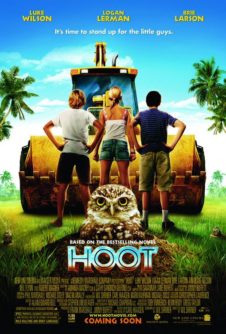
HOOT
A funny, hopeful family adventure with one lesson to discuss.
Should You Watch It?
If you want a funny family movie that treats young people as capable of making a difference, HOOT is worth your time. Its environmental message is prevalent but not propagandistic, and its story celebrates friendship, cooperation and empowerment.
The movie has rough storytelling and some credibility problems. Its central weakness is the way vandalism is presented as part of the fight: one character says Roy has “got to start thinking like an outlaw.” That gives parents an important conversation to have, since destruction of property is not the right way to make a difference.
The violence is mild and comical, with several laugh-out-loud moments. For most families, the practical answer is simple: see HOOT, then talk about how young people can pursue justice without breaking the law.
The Story
NO SPOILERS — WE KEEP THE SURPRISESRoy Eberhardt has moved from Montana to a small town in Florida, where he must begin again at a new school. After encountering a bully and spotting a mysterious barefoot boy, Roy starts investigating.
The mystery leads to a construction site where survey stakes keep disappearing. Soon Roy learns that the site threatens a protected owl habitat, and he joins Mullet Fingers and Beatrice in trying to convince the adults to stop the project.
Is It Any Good?
Three stars means HOOT is an enjoyable, funny film with clear weaknesses. The violence is mild and comical, and the movie delivers several genuinely funny, laugh-out-loud moments. Its story of friendship and young people working together gives the movie an appealing heart.
The rough storytelling and completely unbelievable elements keep it from being a stronger film. Still, children, parents and some adults will find themselves entertained, and most audiences will have a hoot.
The Worldview
HOOT presents a light redemptive worldview. It extols friendship and empowers young people to work together and make a difference in the world. Its strong environmental focus centers on children trying to save land containing owl nests from becoming a restaurant site, but the environmentalism does not feel propagandistic.
The movie’s moral weakness is its treatment of vandalism. Mullet Fingers damages property and tells Roy to think like an outlaw. The film can encourage young people to act, but it does not clearly separate empowerment from unlawful behavior. Parents should help children see that meaningful change does not require vandalism or destruction.
The film’s concern for protecting living things can align with the biblical call to stewardship, while its disregard for lawful means needs discernment. Scripture says, “The LORD God took the man and put him in the garden of Eden to work it and keep it” (Genesis 2:15).
The Content Guide
The specifics — spoilers included by nature — so you can judge for your own family.
Content Summary
Light redemptive worldview with positive moral elements where friendship is extolled and young people are empowered to work together and make a difference in the world, plus some strong Environmental focus as children try and save a plot of land where owl nests are from being turned into a restaurant but these elements do not seem propagandistic; no obscenities but some light phrases such as “we’re screwed” and substitute words like “darn”; light violence centers around a bully who has it in for the new boy in school, bully pushes boy’s face against window of the school bus in response boy punches bully in the nose and breaks it, a golf ball hits boy in the head twice, bully and his mom wrestle over an apology letter that has been given to them, bully drags boy into school janitor closet to beat him up but boy escapes, bully is seen after he has been tied up to a tree wearing just his boxer shorts, blood is seen from a dog bite on another boy’s arm, bully falls onto a bunch of mousetraps, some quick cuts of alligators snapping at people and guard dogs chasing boy; no sexual content; naturalistic upper male nudity as children are in swimsuits and bully is shown in his boxers as he is tied up to a tree; no alcohol; no smoking; and, miscellaneous immorality includes children lying to a doctor (but the doctor knows they are hiding something and it is actually quite comical) and a boy vandalizes a construction site and spray-paints a police officer’s squad car to keep the adults from plowing the ground where the owl’s nests are.
Talk About It
Questions for the drive home, the dinner table, or the youth group.
Roy and his friends believe young people can make a difference. What is one good change you could pursue with others, and what lawful steps would it require?
1 Timothy 4:12 · Galatians 6:9–10The characters care about protecting a natural habitat. What does it mean to “work” and “keep” what God has entrusted to us?
Genesis 2:15 · Psalm 24:1The movie presents vandalism as part of a campaign to stop the restaurant. Why is a good goal not enough to justify a wrong action?
Romans 12:17–21 · 1 Peter 2:12Roy, Mullet Fingers and Beatrice work together despite difficult circumstances. How can friendship help you do what is right?
Ecclesiastes 4:9–10 · Proverbs 27:17The Final Word
HOOT is a funny, enjoyable story about friendship and young people finding the courage to act. Its environmental message is approachable, but its vandalism needs a clear family conversation. For an entertaining family outing with something worthwhile to discuss, WORTH THE TRIP.