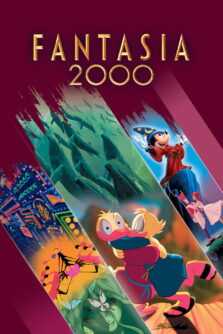
FANTASIA 2000
Mixed Blessings
What You Need To Know
The original FANTASIA animated classic from Walt Disney was meant to be regularly updated by new cartoon segments, combined with classical music. Walt’s surviving brother, Roy, has waited until now, however, to do that. This time, the concept is being brought to the Really Big Screen, the IMAX format.
FANTASIA 2000 has seven brand new sequences and brings back an old favorite of many people, “The Sorcerer’s Apprentice.” Its blessings are mixed, however.
The best of the new sequences comes directly from the Bible’s story of Noah’s Ark and features Donald Duck and Daisy. It’s a charming, emotional tale of Donald getting separated from Daisy, done to the tune of Sir Edward Elgar’s “Pomp and Circumstance.” Donald helps Noah herd the animals into the ark, but thinks his wife Daisy has failed to come aboard. Meanwhile, Daisy thinks Donald has missed the boat because he just barely got on in time after searching unsuccessfully for her. The whole story ends with great emotion. It’s the most fully realized piece of animation since last year’s THE PRINCE OF EGYPT. Director Francis Glebas and Art Director Daniel Cooper deserve special kudos. Perhaps for the next FANTASIA, they should try to bring to life Handel’s “Messiah.”
The second best segment is one based on George Gershwin’s marvelous jazz symphony, “Rhapsody in Blue.” This sequence links four separate stories: one involving a construction worker who would rather be a jazz drummer, an unemployed man looking for work, a henpecked husband, and a clumsy little girl who would rather be playing with her ball than learning to sing, play piano and dance ballet. This is a funny, colorful sequence that all comes together in the end.
The third best sequence is the short piece that opens the movie, an abstract rendition of Beethoven’s great composition known as Symphony No. 5. In this sequence, colorful butterfly-type shapes are menaced by a horde of black and red butterfly shapes until a shaft of light brings them to safety. Like the Noah’s Ark segment, this one has a religious theme that can be used in a positive way for film evangelism. It is too short, however, and audiences may long to hear more Beethoven.
The four other new segments are of varying quality. Of these, the comical one about a flamingo with a penchant for yo-yos is the most enjoyable, although the comical possibilities are not fully realized. More work also should have been done on the sequence based on “The Steadfast Tin Soldier” by Hans Christian Anderson. It’s a simple rendition of a battle between a Tin Soldier with one leg and a villainous Jack-in-the-Box that’s more scary than exciting or wondrous. A third segment, about some mystical flying whales, has a surprise at the end, but it goes on much too long, despite its magnificent music, Ottorino Respighi’s “Pines of Rome.” Finally, the worst of the segments is the one which, regrettably, ends the movie, a Bambi-like ode to nature based on Igor Stravinsky’s “Firebird Suite.” In it, a demonic nature sprite brings the forest back to life after it’s been destroyed by an angry volcano, whose lava is depicted as a fiery bird of prey. The pagan connotations of this final segment, combined with the strong Bible-oriented segment featuring Noah’s Ark and Donald Duck, give a politically-correct air of pluralism to FANTASIA 2000. Pluralism cheapens truth, and the Firebird sequence fails to teach viewers that lava flows from volcanoes are just as much a part of nature as vibrant green forests full of majestic deer. Many viewers will wish they had left the show after the Noah’s Ark segment, which is the one right before the Firebird sequence.
Finally, of course, there is the famous “Sorcerer’s Apprentice” starring Mickey Mouse. Although Mickey learns that absolute power corrupts absolutely, “The Sorcerer’s Apprentice” contains many scary images that are known to frighten younger children. Not the least of these are the flaming yellow eyes of Mickey’s ill-tempered boss. (Those walking broomsticks can be quite frightening, too.) Other images in the movie are also scary.
FANTASIA 2000 uses the big IMAX format well to tell its stories, especially when the screen is filled with butterflies, whales, animals, and broomsticks. In one scene, Daisy looks for Donald and Donald looks for Daisy in a way which shows the future storytelling possibilities this larger format can have for filmmakers. The movie should have included some brighter colors and sharper geometric shapes, however.
Despite the effort that obviously went into this production, FANTASIA 2000 leaves one wishing that Disney had indeed tried to do Handel’s “Messiah.” It also makes one wish for some Bach, some Mozart and perhaps even some waltzes by Strauss. And, why not throw in some science fiction images or some 3D animation into the mix? Compared to all these possibilities, the choices that were made seem somewhat dull, obtuse and perplexing.
Did we mention Handel’s “Messiah” yet?