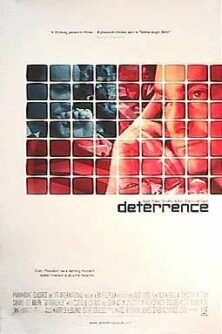
DETERRENCE
An interesting nuclear crisis thriller best kept at home for discerning adults.
Should You Watch It?
Deterrence offers an interesting, sometimes provocative exercise in international politics and nuclear warfare. Kevin Pollak, Timothy Hutton, and writer-director Rod Lurie handle the basic drama of the international crisis well. The president’s surprising, unique, and relatively moral resolution gives the story real weight.
But the movie is also confusing in places, with situations and characters in the diner that can feel corny and pretentious. Its R rating is chiefly earned by strong foul language, with additional concerns involving violence, drinking, smoking, and racial epithets.
The film’s vague religious viewpoint may trouble Christian viewers, though the source review says it does not clearly drive the president’s decisions. Watch at home, if at all, where discerning adults can judge its ideas and content carefully.
The Story
NO SPOILERS — WE KEEP THE SURPRISESSet in 2008, the film follows President Walter Emerson, America’s first Jewish president, during an international crisis involving Iraq. While campaigning with his aides, Emerson becomes snowed in at a Colorado diner near NORAD.
When Iraqi forces threaten the oilfields of Saudi Arabia and Iraq prepares its own weapons of mass destruction, the president must make decisions with global consequences. The crisis becomes a test of leadership, judgment, and nuclear deterrence.
Is It Any Good?
Two stars means this is an interesting but uneven political thriller. Pollak, Hutton, and Lurie handle the central international crisis well, and the movie’s resolution is surprising, unique, and relatively moral.
The film’s weaknesses are substantial. Parts of the story are confusing or not explained clearly. Some of the diner situations and characters are corny and pretentious. The movie has worthwhile ideas, but its execution falls short of its ambitions.
The Worldview
The film presents a mild moral worldview. It ultimately seems to side with the president’s surprising and relatively moral resolution of the crisis, suggesting that leadership decisions involving warfare and nuclear weapons carry serious moral weight.
At the same time, the president identifies himself as an atheist in a moment the source review describes as pretentious and gratuitous. The film does not clearly show that atheism affecting his decisions, leaving the religious viewpoint questionable and vague. It also includes a politically correct treatment of another character’s racist attitudes, which the source review found corny.
The source review argues that politics and God should be connected when societies make decisions about morality, family, civil society, crime, and warfare. The film raises those questions without offering a clear biblical answer. Scripture says, “The fear of the LORD is the beginning of wisdom” (Proverbs 9:10).
The Content Guide
The specifics — spoilers included by nature — so you can judge for your own family.
Content Summary
Mild moral worldview with a main character claiming to be an atheist & a politically-correct element about the racism of another character; 52 mostly strong obscenities, 10 mostly strong profanities & a few racial epithets; shootout in diner, with some bloody after-effects shown; no sex; no nudity; some casual beer & wine drinking, especially by one beer-drinker who gets a bit inebriated; smoking; and, racism, anger & political leader makes snap decisions that are belligerant.
Talk About It
Questions for the drive home, the dinner table, or the youth group.
What responsibilities come with political power, especially when a leader is making decisions about warfare?
Romans 13:1–4 · Proverbs 11:14The film connects politics with moral judgment. How should Christians bring biblical wisdom to decisions affecting civil society and human life?
Micah 6:8 · James 1:5How can strong language, anger, and snap decisions shape the way people respond to a crisis?
Proverbs 15:1 · Ephesians 4:29What does Scripture teach about the fear of God, and how is that different from merely appearing morally serious?
Proverbs 9:10 · Ecclesiastes 12:13The Final Word
Deterrence has an interesting central crisis and a relatively moral resolution, but confusing storytelling, pretentious characters, strong language, and other adult content limit its audience. WAIT FOR HOME — ADULTS ONLY is the prudent choice. For safer family viewing, see.