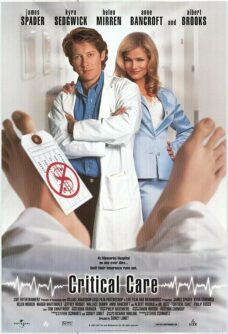
CRITICAL CARE
An able hospital satire that turns euthanasia into dangerous propaganda.
Should You Watch It?
CRITICAL CARE is a skilled, probing dark comedy about a hospital’s treatment of a comatose patient. Its acting is top-notch, its sterile visual design emphasizes the depersonalization of critical care, and it raises serious questions about greed, terminal illness, “playing god,” and the afterlife.
But the film’s moral center is confused. It presents nurse-assisted suicide and supports euthanasia while attacking Christian convictions through a hypocritical Christian character. Its treatment of death, heaven, hell, and God omits the Christian salvation message. Sexual situations, foul language, nudity, alcohol abuse, smoking, and other immoral behavior add to the concerns.
You may find the ethical questions worth discussing, but the film’s propaganda potential and excessive content make the practical answer clear: skip it.
The Story
NO SPOILERS — WE KEEP THE SURPRISESDr. Werner Ernst is a second-year resident physician in a major hospital’s critical care unit. Mr. Potter, a 74-year-old man in a coma with little chance of recovery, has two daughters who disagree about whether his life support should continue.
The hospital wants to maintain treatment because it is making money from Mr. Potter’s insurance. As Dr. Ernst is pulled between hospital policy, legal pressures, family conflict, and his own conscience, the case exposes questions about medicine, inheritance, and personal greed.
Is It Any Good?
Three stars means this is a capable, thoughtful film whose strengths cannot overcome its troubling message and content.
The acting is top-notch. James Spader is adept and usually creepy as Dr. Ernst, while the film’s lighting and set design emphasize the depersonalization of a sterile critical care unit. The script is complex and character driven, and the movie makes a strong statement that doctors, nurses, hospitals, and health insurance companies may not always act in patients’ best interests.
The film is also cynical and difficult to recommend as general entertainment. Its clinical treatment of dying people and confused morality make its craft serve an ultimately dangerous argument.
The Worldview
CRITICAL CARE wrestles with life and death through a pagan worldview containing both Christian and anti-Christian elements. It recognizes heaven, hell, the devil, and God. One conscious terminal patient is visited by a demon who says he did not love God or his neighbor. The man ultimately says he wants to go with God, but the film never mentions Jesus Christ or the Christian salvation message.
A nun tells Dr. Ernst that loving others is the greatest thing people can do on earth. That echoes Jesus’ teaching about loving God and neighbor. Yet the movie also portrays a Christian character as hypocritical, suggesting that her religious convictions conceal greed. The review finds that this defames Jesus Christ, while the film’s nurse-assisted suicide and support for euthanasia further distort a biblical view of human life and death.
The film is especially concerned with what happens when powerful institutions decide whose lives should be maintained. Its warning about greed and treating dying people as clinical objects has force. But its apparent support for euthanasia could strengthen a movement that places vulnerable people at risk and may be used for eugenic purposes. The central Christian answer is not simply love or a chosen death, but salvation through Jesus Christ: “You shall love the Lord your God with all your heart and with all your soul and with all your mind” (Matthew 22:37).
The Content Guide
The specifics — spoilers included by nature — so you can judge for your own family.
Content Summary
Pagan worldview of wrestling with life & death issues with Christian & anti-Christian elements; 15 obscenities, 7 profanities & some hypocritical remarks; woman helps man die by withholding medical care; strong scene of stripping & foreplay with implied fornication; women in underwear & upper male nudity; alcohol use & abuse; smoking; and, lying, hypocritical attitudes & behaviors
Talk About It
Questions for the drive home, the dinner table, or the youth group.
The film raises the question of whether a patient’s life should be maintained. What does Scripture say about the value of human beings, including those who are weak or dependent?
Genesis 1:27 · Psalm 139:13–16The movie connects medical decisions with greed and insurance money. How should Christians respond when financial interests compete with care for vulnerable people?
Proverbs 31:8–9 · Philippians 2:3–4A demon tells a dying man that he did not love God or his neighbor. What do Jesus’ two greatest commandments require, and why is love of God more than merely being kind?
Matthew 22:37–40 · 1 John 4:9–10The film presents euthanasia as a solution. How is trusting God amid suffering different from deciding that a person’s life no longer has value?
Job 1:20–22 · Romans 14:7–8The Final Word
CRITICAL CARE is well acted and raises serious questions about terminal care. But its excessive content, confused morality, attack on Christian convictions, and support of euthanasia make it a poor choice for your family or conscience. Our answer is SKIP IT. For better options, see.