
PIRATES OF THE CARIBBEAN: THE CURSE OF THE BLACK PEARL
A rollicking, funny pirate romp — with a pagan curse worth knowing about.
Should You Watch It?
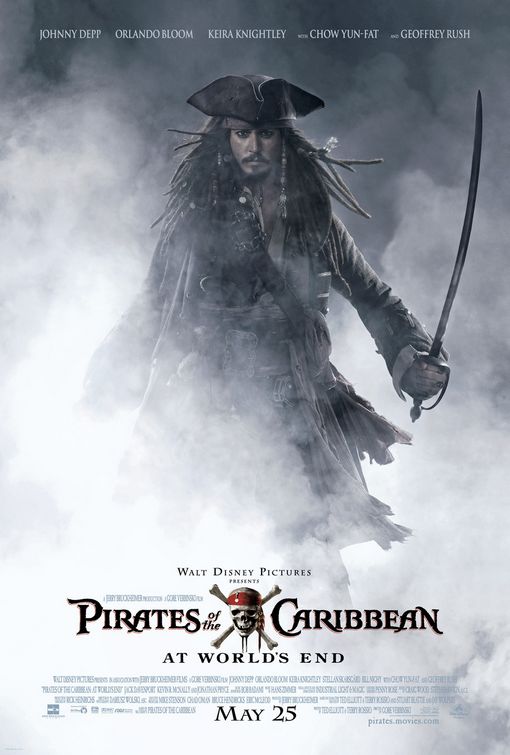
Yes — with your eyes open. This is a four-star pirate movie in the truest sense: funny, fast, full of derring-do, and anchored by a career-making performance from Johnny Depp, who plays Captain Jack Sparrow like a man perpetually half-crazy and half-tipsy, yet always scheming to win his ship back. Orlando Bloom and Keira Knightley give the story its heart and heroism, and Geoffrey Rush relishes his villainy without tipping the film into darkness it can't handle.
The catch is real, though not deal-breaking for most families with older kids. The film carries a pagan, occult curse — an Aztec treasure that dooms a crew of pirates to walk as living skeletons — and that element undercuts what could have been a stronger, cleaner redemptive ending. There's also plenty of action violence, some drunkenness, and a bit of crude humor.
For older children through adults, this is a genuinely fun ride from the safety of a theater seat. For younger or more sensitive viewers, wait and preview it first.
The Story
NO SPOILERS — WE KEEP THE SURPRISESCaptain Jack Sparrow loses his ship, the Black Pearl, to his treacherous rival Captain Barbossa. Years later, Sparrow washes up in Port Royal, where he's promptly clapped in irons — until Barbossa's crew raids the town and kidnaps the governor's daughter, Elizabeth. Her childhood friend Will Turner teams up with Sparrow to chase down the Black Pearl and rescue her, while a debonair naval officer pursues them both. What none of them yet realize is that Barbossa's crew is hiding a secret far stranger than piracy.
Is It Any Good?
Four stars means this earns its reputation as genuine, rewatchable entertainment, and the source's praise holds up point for point. Depp's performance is the engine — inventive and eccentric rather than a straightforward swashbuckling hero, which gives Bloom and Knightley room to carry the film's heroism and romance. Their early sword-fighting scene is a highlight, and Rush's villainy adds gleeful energy even though the film lacks a truly menacing antagonist.
Director Gore Verbinski, working with producer Jerry Bruckheimer, keeps the tone light and comic without losing momentum, even when the plot occasionally lags. It's a movie built for repeat viewing — polished, funny, and confident in its own fun.
The Worldview
This is, at its best, a light redemptive story: a young man risks everything for love, a young woman offers herself as a hostage to protect a town, and a rogue pirate is driven by a hope for freedom that makes him clever rather than merely selfish. Those are threads Scripture recognizes — sacrifice, loyalty, courage under pressure.
But the film's pagan Aztec curse, which turns Barbossa's crew into living skeletons under moonlight, introduces real occult imagery, and it blunts the story's moral force. A stronger, cleaner ending could have kept the curse's plot mechanics while sharpening the redemptive payoff; instead, the film settles for something murkier, including loose talk about being a "good" bad man — a wink at moral relativism that families should be ready to talk through.
Jack Sparrow's whole scheme is driven by a longing for freedom, symbolized by his stolen ship. It's a longing every human heart recognizes, but the freedom this film imagines is freedom to do as one pleases — not the freedom Scripture offers. "For freedom Christ has set us free" (Galatians 5:1), but that freedom is meant for love and service, not license. That's worth naming out loud after the credits roll.
The Content Guide
The specifics — spoilers included by nature — so you can judge for your own family.
Content Summary
Light redemptive worldview with some moral elements but also with some strong pagan and occult elements; a couple British obscenities and about two light exclamatory profanities; plenty of action violence and some scary violence including images of hanged bodies, much sword fighting, pistols fired pointblank at people, explosions, pirates storm through town, living skeleton men frighten young woman, skeleton men attack soldiers and other people, young man almost drowns, and small cuts on hands to remove curse; no sex scenes but pirates hang around with loose women in one scene; woman in old-fashioned underwear, female cleavage, and upper male nudity; alcohol use and drunkenness; no smoking; and, piracy and moral relativism such as talk about being a “good” bad man.
Talk About It
Questions for the drive home, the dinner table, or the youth group.
Jack Sparrow's whole quest is driven by a longing for freedom. What kind of freedom does Scripture actually offer, and how is it different from "doing what I want"?
Galatians 5:1, 13Elizabeth offers herself as a hostage to protect the town. What does real courage on behalf of others look like, and where do you see it in the Bible?
John 15:13 · Philippians 2:3–4The film has characters talk about being a "good bad man." Can a person really be both? What does Scripture say about mixing good deeds with a bad heart?
Matthew 7:17–18 · James 3:11The Aztec curse and living skeletons are treated as spooky fun, but they're rooted in real occult ideas. How should Christians think about entertainment that dabbles in curses and the paranormal, even playfully?
Deuteronomy 18:10–12 · Ephesians 5:11The Final Word
Depp, Bloom, Knightley, and Rush make this a swashbuckling jolly good time, full of humor and derring-do — genuinely one of the better pirate movies Hollywood has made. It carries a pagan curse and some scary imagery worth knowing about beforehand, but for older kids and up, it's a fun, well-made ride. Same answer we opened with: worth the trip — older children and up.