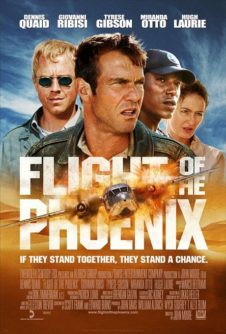
FLIGHT OF THE PHOENIX
An exciting survival adventure best saved for discerning teens and adults.
Should You Watch It?
Flight of the Phoenix is a well-plotted, exciting survival adventure. Its excellent storm sequences and special effects create real urgency as a stranded group tries to survive in the Mongolian desert.
The film also has a worthwhile idea at its center: people need hope and something to do, and difficult circumstances eventually force this group to pull together. But the beginning is slow and stilted, and the movie falls short of the profound story it might have been.
The main cost is content. There is no sexual activity, but the film contains constant foul language, intense violence, upper male nudity, and a mixed worldview. Save it for home, and use discernment for teenagers and adults.
The Story
NO SPOILERS — WE KEEP THE SURPRISESPilot Frank Towns and co-pilot A.J. travel to Mongolia to evacuate an oil excavation operation. After the crew takes off, a powerful sandstorm brings their plane down in the desert.
Stranded without a radio and with little hope of survival, the group must decide how to endure. Elliott proposes rebuilding the damaged plane and flying out. As pressure mounts, their worst qualities emerge—but survival may require them to work together.
Is It Any Good?
Three stars means this is a solid, entertaining adventure with notable flaws. The movie quickly moves from a stilted beginning into a furious pace, and the special effects and storm sequences are excellent.
Its plot is strong enough to sustain the survival premise, and the group’s struggle creates genuine excitement. Still, the film is not profound, even though it could have been. Stilted dialogue, funky acting, constant foul language, and insufficient attention to detail keep it from becoming one of the year’s better movies.
The Worldview
The film presents an eclectic spiritual outlook. One character dismisses religion while speaking about spirituality. Another prays and thanks God for everything. There are also references to luck, a lucky medallion, jinxing, and a man who may actually be cursed. Crosses appear for dead colleagues, while the hero says he is not prepared to make statements at a funeral.
There are clear elements of redemptive activity and prayer, along with the idea that people need love, hope, and purposeful work. But those elements are weakened by the film’s mixed treatment of religion. The pilot rejects belief even while kissing a lucky medallion, and the story leaves room for superstition and possible cursing rather than offering a clear biblical understanding of God’s providence.
The film’s central longing is hope in a desperate situation. Scripture points to a hope grounded not in luck or curses but in God: “May the God of hope fill you with all joy and peace in believing” (Romans 15:13).
The Content Guide
The specifics — spoilers included by nature — so you can judge for your own family.
Content Summary
Eclectic pagan worldview with character who dismisses religion but talks about spirituality, another character who prays and thanks God for everything, a hero who says he is not prepared to make any statements at a funeral, and crosses used for dead colleagues, as well as references to luck, kissing a medallion and references to a man jinxing a project; 44 obscenities and 10 profanities; lots of action violence, some of it very intense, such as a plane going through a sandstorm, man falls through back of plane to his death, people beaten, point-blank executions, splattering blood, gunfights, fist fights, man’s face sanded off by sandstorm, and corpses; one kiss and some references to sex, but no other sexual activity; lots of upper male nudity in the desert; references to alcohol; smoking; and, very minor elements such as revenge and lying. GENRE: Action-adventure
Talk About It
Questions for the drive home, the dinner table, or the youth group.
When the group loses almost every ordinary source of help, what gives people genuine hope? How is biblical hope different from luck?
Romans 15:13 · Hebrews 6:19The characters’ worst qualities emerge under pressure, but they eventually must work together. What does pressure reveal in us, and how can Christians respond differently?
James 1:2–4 · Philippians 2:3–4One character prays and thanks God, while others dismiss religion or trust in luck. What does it mean to acknowledge God in an uncertain situation?
Proverbs 3:5–6 · 1 Thessalonians 5:16–18The group needs purposeful work in order to keep going. How can ordinary responsibilities become a way to serve others?
Colossians 3:23–24 · Galatians 6:9–10The Final Word
Flight of the Phoenix delivers exciting survival filmmaking and a strong theme of hope and cooperation. But constant foul language, intense violence, nudity, and a mixed worldview make it better for discerning teens and adults at home. Our answer is WAIT FOR HOME — AGES 13 AND UP.