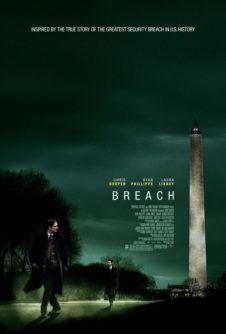
BREACH
An absorbing spy drama with Christian themes, adult content, and moral complications.
Should You Watch It?
Breach offers a thoughtful true-story spy drama rather than the relentless political thriller its marketing promises. It is well directed and well told, with strong performances from Chris Cooper and Laura Linney. The film also includes positive references to Christianity, patriotism, and serving one’s country.
But the story’s most religious and devout character is also considered one of the worst spies in U.S. history. That tension gives the film moral weight, while also showing how religion can be used as a cover for deceit. The movie includes cautionary sexual material, sexual discussions, mild violence, and foul language, including one “f” word.
If you are an adult—or an older teenager—with the discernment to weigh those concerns, Breach is worth your time. For children and young teens, choose something else.
The Story
NO SPOILERS — WE KEEP THE SURPRISESYoung FBI hopeful Eric O’Neill is recruited into an inter-agency investigation and assigned to spy on his new boss, Agent Robert Hanssen. The team tells Eric that Hanssen is a sexual deviant, but Eric sees a deeply devout Catholic who loves his wife and grandchildren.
As Eric presses for the truth, the investigation takes a more serious turn. Hanssen becomes increasingly wary of whom he can trust, and Eric finds himself caught in a dangerous effort to expose his boss.
Is It Any Good?
Three stars means Breach is a high-quality, enjoyable film with noticeable limitations. Billy Ray directs the story capably, and Chris Cooper and Laura Linney give wonderful performances. The film’s real-life subject also leaves viewers wanting to explore more about Robert Hanssen.
Ryan Phillippe seems one-dimensional at times and is the movie’s weak link. Despite marketing that suggests a taut, edge-of-your-seat thriller full of twists, the film feels a little flat and is not nearly as intense as the trailers make it seem.
The Worldview
The film contains strong religious overtones, many references to Christianity and Catholicism, and positive themes involving prayer, faith, patriotism, and serving one’s country. It also rebukes Communism and atheism, including the statement that the Soviet Union failed because of “godlessness and atheism.”
At the same time, Breach complicates its religious themes through Robert Hanssen. He is presented as deeply devout, with references to the rosary, Mass, Confession, Christ, prayer, and living out one’s faith. Yet he is also a treasonous spy who uses religion to avoid suspicion, though his actions are eventually discovered and punished. The film therefore shows that religious appearance is not the same as righteousness.
The story also contains a negative view of homosexuality, including dismissive dialogue about same-sex marriage and a photographer portrayed as effete. These elements are part of the film’s political and cultural perspective.
The film’s central warning is about deceit hidden beneath respectable appearances. Scripture says, “You will recognize them by their fruits” (Matthew 7:16).
The Content Guide
The specifics — spoilers included by nature — so you can judge for your own family.
Content Summary
Strong biblical worldview with many references to Catholicism and Christianity, although the strongest religious character is also a treasonous spy, but he is discovered and punished for his actions, many references to Christ, prayer, the Lord, and phrases like “God expects you to live your faith every day,” as well as Catholic elements such as praying the rosary, going to Mass and Confession, plus strong political elements such as patriotism and serving one’s country, the movie is set in a post-Communist era where spy traded U.S. secrets to the Soviets and Communism is rebuked and character even states that the “Soviet Union failed because of godlessness and atheism” with comments of how the CIA and FBI do not work together, and elements of a negative view on homosexuality as photographer is portrayed as effete and religious character says the “world doesn’t need anymore Hillary Clintons” and he rebukes a political activist he saw on TV who was defending same-sex marriage; nine obscenities (including one "f" word) and eight profanities (mostly “Dear Lord,” and “my God” ), plus several instances of name-calling as boss tells employee he is an imbecile, idiot, etc.; very mild violence includes two Soviet spies are shot in the head in a dark corridor, gunfire on a shooting range and spy fires gun by the head of his assistant in order to scare him; some sexual content includes man is described as a sexual deviant by using graphic terms during a discussion, married kissing, married couple has implied sexual encounter, home-made pornographic video is found and watched with accompanying sound heard, and implied masturbation; light naturalistic nudity of woman’s cleavage in a nightgown; alcohol consumption is discussed but rebuked for FBI agents, one scene of alcohol consumption depicted and character is implied as being drunk; no smoking or drug use; and, strong miscellaneous immorality includes lies and deceit in political games between spies and agencies and man must lie to his wife for his job.
Talk About It
Questions for the drive home, the dinner table, or the youth group.
The film contrasts religious devotion with dishonest actions. How can your daily choices show whether your faith is genuine?
Matthew 7:16 · James 2:17Eric is asked to deceive his boss while serving a larger investigation. When, if ever, should a person keep a confidence, and when must truth be told?
Proverbs 12:22 · Ephesians 4:25The story connects national service with moral responsibility. How should Christians think about serving their country while remaining faithful to God?
Romans 13:1–4 · Acts 5:29Characters use labels and insults during political conflict. What does Scripture require of us when we disagree with others?
Ephesians 4:29 · Colossians 4:6The Final Word
Breach is a well-directed, well-acted spy drama with meaningful Christian references and a serious warning about deceit. Its sexual content, profanity, and moral complications make it unsuitable for children and young teens. For discerning adults and older teenagers, it is WORTH THE TRIP — ADULTS ONLY. Families seeking cleaner viewing should begin with.