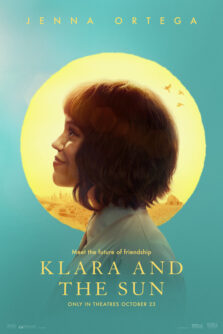
KLARA AND THE SUN
A surprising and bittersweet story that reveals the value of human life through the perspective of an AI companion.
Should You Watch It?
Yes, but with some caution. This movie offers a surprisingly moving exploration of humanity and sacrificial love, but its pagan worship of the sun and its mockery of faith call for a strong biblical filter. What begins as a lighthearted story about an AI companion gradually darkens into a dystopian drama, then ends with a beautiful, bittersweet conclusion. Rather than arguing that artificial intelligence can replace human friendship, the movie uses an artificial being to reveal what makes humanity irreplaceable.
The story’s greatest strength is its critique of a world that measures human worth by intelligence, ability, and usefulness. It challenges the pursuit of genetic superiority and reminds viewers that love, virtue, and human dignity can’t be reduced to productivity or replicated through technology. Its portrayal of self-sacrifice invites a Christian interpretation.
However, the movie’s actual spirituality is pagan. Klara worships the sun as a healer and credits it with a miracle. Other characters mock her belief, suggest faith in any god reflects a weak mind, and claim nothing about humans is unique. The only mention of God comes from a mother angrily blaming Him for her suffering.
Parents should note some violence, including a scene with an AI stabbing itself in the neck, and occasional profanity, including one use of the F-word. The story also explores terminal illness, death, and grief. Viewers seeking a thoughtful science-fiction drama with a hopeful message will find much to appreciate. Ultimately, the movie reminds audiences that what makes us human can’t be programmed, but it never points to the God who made us that way.
The Story
NO SPOILERS — WE KEEP THE SURPRISESIn a futuristic society where some children undergo genetic enhancement to become exceptionally intelligent, Klara, an unusually empathetic artificial intelligence, is purchased as a companion for Josie, a seriously ill teenage girl.
As Klara adjusts to life with Josie and her family, she discovers the complexities of human relationships, suffering, and love. Convinced the Sun has life-giving power, Klara hopes it can help Josie. Meanwhile, the family's struggles reveal a society increasingly shaped by technological advancement and the pressure to become better, smarter, and more capable.
Is It Any Good?
Three stars for an unexpectedly effective and emotionally resonant science-fiction drama. Its gradual shift from a lighthearted introduction to a dystopian premise creates an intriguing sense of discovery, even if the tonal transitions occasionally feel abrupt. The story ultimately finds its footing in an emotionally satisfying and bittersweet conclusion, though the mature themes mean kids should skip this one.
Klara’s childlike wonder and earnest devotion provide much of the movie’s emotional power. The relationships ground its philosophical questions in recognizable human struggles: grief, parental expectations, loneliness, and the desire to be loved for who we are.
The movie’s most compelling moments are those in which its themes become actions rather than explanations, particularly one character’s climactic act of self-sacrifice. Some of the social commentary is more direct than subtle, and the resolution leaves certain questions unanswered.
Director Taika Waititi’s eclectic style, tone, and occasionally uneven plot make for an unusual viewing experience that may not be everyone’s cup of tea. Nevertheless, the movie’s emotional sincerity and thought-provoking premise make it a rewarding experience. It beautifully turns a familiar premise about artificial intelligence into a commentary on what makes life meaningful.
The Worldview
This movie presents a mixed pagan and humanist worldview with some anti-biblical content and strong moral elements. The movie rightly defends human dignity and sacrificial love, but it borrows those truths from the Christian faith while it denies the God who gives them meaning.
The pagan elements center on Klara, who worships the sun as a divine healer. She prays to it for Josie and credits it with a miracle. Scripture warns against such worship, since the sun only reflects the glory of the One who made it. Some viewers may see echoes of Christ, the Light of the World, but the story never points beyond creation to the Creator.
Humanist and anti-biblical elements surface as other characters mock Klara’s belief and imply that faith reflects a weak mind. One character claims a machine can recreate any human quality, a view that reduces people to parts. The only mention of God comes from a bitter mother who accuses Him of cruelty, and the story never answers her. Yet God forms each person in His image, and no machine can copy a soul.
Ironically, the movie’s own story affirms these biblical truths. The genetically enhanced children known as the Lifted equate intellect with worth, and their arrogance and cruelty expose the pride behind that belief. Rick, an unenhanced boy, shows the humility and care no genetic upgrade can guarantee. Klara gives up herself for Josie, the very kind of love Jesus calls the greatest (John 15:13). Too bad the movie thanks the sun and forgets the One who made it (Romans 1:25).
The Content Guide
The specifics — spoilers included by nature — so you can judge for your own family.
Content Summary
Dominant Worldview and Other Worldview Content/Elements
Mixed pagan, humanist worldview with strong moral, redemptive elements, as an artificial friend sacrifices herself for a sick girl, the story rebukes a society that equates intelligence with human worth, and an unenhanced boy shows the humility and care genetic engineering cannot produce, marred by pagan elements as the heroine worships the sun as a divine healer, prays to it for the girl’s recovery, and credits it with a miracle, plus humanist, materialist elements when characters mock faith in any god as the sign of a weak mind and one character claims a machine can recreate any human quality, and light anti-biblical content when a doctor suggests prayer only as a last resort and a bitter mother claims God has wronged her twice
Foul Language
One “f” word, along with uses of GD, the “d” word, “bs,” and “crap”
Violence
Light violence mainly against robots, as several get tossed across a room, one gets cut up in a wheat harvester, a human character tries to drown an AI before realizing it doesn’t need to breathe, and another AI gets stabbed in the neck and oozes purple liquid; a human girl bleeds from her nose and collapses
Sex
Mention of the word “sex,” and a character says the AI companions don’t have female genitalia
Nudity
No nudity
Alcohol Use
Adult characters drink wine, and one becomes mildly intoxicated
Smoking and/or Drug Use and Abuse
A character takes prescription drugs for illness, and one character smokes;
Miscellaneous Immorality
A mother and daughter frequently argue, a character plans to replace a dead character with a robotic replica, and a slight implication of racism.
Talk About It
Questions for the drive home, the dinner table, or the youth group.
What gives a human being inherent value? The society in the movie places extreme importance on intelligence and genetic enhancement. How does the film challenge the idea that a person's worth depends on their abilities or achievements? Psalm 139:13–14.
What is the difference between loving someone and trying to control their future? How can good intentions become harmful when we prioritize our plans over the needs of the people we love? 1 Corinthians 13:4–7.
Can something have value even if it serves no practical purpose? The movie challenges a society that measures people and things by their usefulness. How do friendship, art, beauty, and the natural world reveal the limitations of that way of thinking? Ecclesiastes 3:11.
What does self-sacrifice teach us about love? How does willingly putting another person's good before our own reflect Christ's example, and what might that look like in our own lives? John 15:13.
The Final Word
KLARA AND THE SUN uses a futuristic premise to explore human dignity, faith, and love. Despite uneven tonal shifts, its emotional payoff and critique of a society obsessed with superiority make it a worthwhile yet complicated watch. Its pagan sun worship and foul language call for caution. Parents should watch with teens and discuss why worship belongs to the Creator, not the sun, how God gives every person dignity, and how Jesus offers true hope in grief.