FLOW
A wordless masterpiece about outcasts learning to survive together.
Should You Watch It?
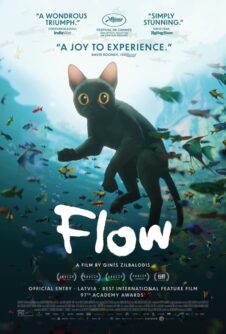
FLOW is something rare: a completely wordless animated film that still says everything worth saying. A cat loses his home to a flood and is forced to survive alongside animals he'd normally avoid — a dog, a bird, a capybara, a lemur, even a whale. What emerges is a hushed, gorgeous meditation on community, cooperation, and compassion for the outcast.
The cost is mild but real. This isn't a lighthearted romp; the animals face continuous, life-threatening peril, and the main character nearly drowns more than once. The story also carries echoes of Noah's Ark braided with some Eastern religious undertones — nothing preachy, but worth knowing going in.
If you have older children or are simply looking for beautiful, thoughtful filmmaking, this one rewards you richly. If your children are very young or easily frightened, wait until they're a bit older.
The Story
NO SPOILERS — WE KEEP THE SURPRISESIn an unnamed land that looks something like Madagascar, a solitary cat's home is swallowed by a sudden, catastrophic flood. Alone and adrift, he finds refuge on a boat — and, one by one, other displaced animals climb aboard. Natural enemies are forced into uneasy company as they search for solid ground. From here, the film asks a simple question with no dialogue at all: can creatures this different learn to survive as one?
Is It Any Good?
Four stars means this is as good as animated filmmaking gets this year, and the craft backs it up. Director Gints Zilbalodis builds the entire film without a single word of dialogue, relying on naturalistic, handheld-style camera movement and free 3D software to create something that feels intimate rather than slick. The soundtrack and the calm, flowing visuals do enormous emotional work, especially as the mood shifts between the water's "scary and aggressive" turmoil and its "tranquil and peaceful" calm, mirroring the animals' own growth from fear to cooperation. It's a genuinely mesmerizing achievement — a silent film in a noisy world.
The Worldview
FLOW exalts something Scripture exalts: creatures who are different from one another choosing compassion and cooperation over fear and division. The film shows an appreciation for God's creation, rebukes prejudice and discrimination when animals mistreat one another, and portrays real self-sacrifice — two animals risk their lives to save the cat, and the cat himself shows tenderness toward a sick, displaced whale. A community forms not because these creatures are alike, but because they choose to need one another.
The film's undertones of Noah's Ark are unmistakable — a flood, a scattered menagerie, survival by huddling together — but they're blended with Eastern religious references that give the story's spirituality a hazier shape than the biblical account it echoes. This isn't preachy or doctrinal; it's atmospheric. Still, discerning families should know the well from which some of this imagery is drawn.
What the film gets right, it gets beautifully right: love and cooperation across difference are not incidental themes here but the whole point. Scripture says it plainly — "Two are better than one, because they have a good reward for their toil. For if they fall, one will lift up his fellow" (Ecclesiastes 4:9–10). FLOW pictures exactly that kind of mutual rescue, even if it can't name the God who designed us for it.
The Content Guide
The specifics — spoilers included by nature — so you can judge for your own family.
Dominant Worldview and Other Worldview Content/Elements
Strong moral worldview with redemptive elements displays an appreciation for God’s creation and promotes kindness, compassion, animals work together in spite of their differences, two animals risk their lives to save Cat, animals develop a community, and Cat has compassion for a sick whale, and the story opens with a flood
Foul Language
No foul language
Violence
Continuous natural disaster related threats and peril throughout, plus the main character almost drowns a few times
Sex
No sex
Nudity
No nudity
Alcohol Use
No alcohol use
Smoking and/or Drug Use and Abuse
No smoking or drugs;
Miscellaneous Immorality
Discrimination and prejudice but rebuked.
Talk About It
Questions for the drive home, the dinner table, or the youth group.
Cat, Bird, Dog, Capybara, and Lemur are natural strangers — even natural enemies — but they learn to work together to survive. What does it look like for your family to welcome and cooperate with people who are different from you?
Romans 12:10 · Ecclesiastes 4:9–10The other Secretary Birds punish Bird for helping Cat. Have you ever seen someone mistreated for showing kindness to an outsider? How should we respond when doing right costs us?
1 Peter 3:14Cat shows compassion to a sick whale who is far from home and out of place. Who are the "displaced" people in your life, and how can you show them the same care?
Leviticus 19:34The film echoes the story of Noah's Ark — creatures crowded together, surviving a flood by sticking together. How does God's covenant after the flood shape how we think about caring for creation and one another?
Genesis 9:8–13The Final Word
FLOW proves you don't need a single word to tell a story that matters. It's a gorgeous, moving picture of outcasts choosing community over isolation — with enough peril to warrant care for your youngest viewers. Our answer stands: worth the trip — older children and adults.