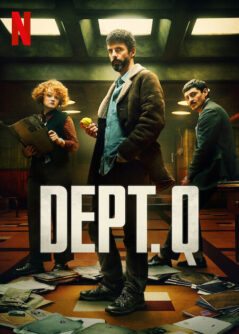
DEPT. Q: Episode 1.1
A gripping Edinburgh cold-case drama — dark, and only for adults.
Should You Watch It?
Here is the decision. Scott Frank has opened his new Netflix series with a genuinely well-made hour of television — gorgeous cinematography of Scotland's capital, a dark and moody atmosphere, and a brooding tension that ebbs and flows nicely. The craft is there, and the final-minute time twist is gripping and chilling.
But this is heavy going. The tone is weighty, with very little levity to lighten it, and the protagonist — DCI Carl Morck — is hard to get behind, nasty on principle in a way the first episode never quite explains. The content matches the mood: brutal violence, a torrent of foul language, and dark themes running through murder, rape references, and suicide.
There is a light at the end. A disabled character turns from wanting to end his life toward purpose and belonging, the most redemptive thread the show has offered so far.
So: if you're an adult drawn to serious crime drama and undeterred by graphic content, this pilot is worth a look — but wait and see where the series goes before committing your evenings.
The Story
NO SPOILERS — WE KEEP THE SURPRISESDCI Carl Morck has a brilliant mind for complex cases and almost nothing else. His life outside work is non-existent, his colleagues find him cranky and critical, and his outlook on life is as dreary as a London fog.
When a masked gunman shoots him in the face at a crime scene, he takes the minimum time off and returns to duty — only to be handed a new, well-funded department buried in the basement, tasked with cracking the coldest of Edinburgh's unsolved cases. With a crew of eccentric aides around him, the work begins.
Is It Any Good?
Four stars, and here is what they mean. This is confident, handsome filmmaking. The cinematography of Edinburgh is excellent, the atmosphere is dark and moody, and the tension is calibrated well — never rushed, never slack. The closing time twist is a real hook.
Its weaknesses are tonal. The relentless heaviness, with almost no levity to relieve it, can wear on you, and the lead is difficult to warm to — his nastiness reads as a principle rather than a wound the story has earned the right to explore. There's hope in the margins: his "eager" assistant, Akram Salim, promises the humor the show badly needs, and by the close an odd but effective team is forming around a man who plainly needs one. A strong start, if a punishing one.
The Worldview
The dominant worldview here is heavily Romantic — feeling, mood, and the tortured inner life of a difficult man drive the story — but genuine biblical moral elements run through it too. Morck himself is deeply troubled and shows minimal regard for other people, yet he does his work well and commits, at least, to standing by a disabled partner.
Other characters carry more moral weight. A middle-aged female lawyer hungers for justice while wrestling with troubles at home, including an adult brother with significant mental problems. Morck's assistant is, so far, the one figure of strong moral fiber without major drawbacks — and the likely source of the show's light.
The most redemptive thread belongs to Morck's partner, paralyzed in an early shootout. In despair, he quietly asks a friend to help him end his life. Later he turns from that path and joins the cold-case team — a real turn from self-destruction toward purpose, and the clearest glimmer of hope in a dark series.
That turn matters, because it names something Scripture insists on: that a life burdened and broken is still worth living, still called toward hope. "Why are you cast down, O my soul, and why are you in turmoil within me? Hope in God" (Psalm 42:11).
The Content Guide
The specifics — spoilers included by nature — so you can judge for your own family.
Dominant Worldview and Other Worldview Content/Elements
The dominant worldview of the series is heavy Romantic with some biblical moral elements throughout. While the protagonist starts out difficult to get behind, supporting characters bring in strong elements to lighten the mood and bring biblical redemptive storytelling into play
Foul Language
40 f words, 2 strong profanities, and 11 obscenities
Violence
A dead man is shown sitting in an easy chair in his front room with dried blood covering his face and an investigating officer says he’s been stabbed in the head; a man leaves the scene and is shot point blank in the face by a masked gunman (he is later shown on the floor, presumably dead, with blood all over his face); other officers on the scene are shown wounded or killed (one has blood on his head and flowing out of his mouth and another is seen with a knife sticking out of his head while the murderer briefly views his handiwork); video of a crime replays past events with gunshots and blood flying in blink and you’ll miss them segments; cases involving rape are briefly mentioned; a character acts a friend to help him commit suicide and later turns from this self-destructive path
Sex
Cases involving rape are briefly mentioned
Nudity
No nudity
Alcohol Use
Multiple people drink beer or other spirits regularly; a cop seems tipsy once
Smoking and/or Drug Use and Abuse
None,
Miscellaneous Immorality
The protagonist seems to have significant baggage and to be generally nasty toward almost everyone. This may be explained or ameliorated later.
Talk About It
Questions for the drive home, the dinner table, or the youth group.
Morck's partner, paralyzed and in despair, asks a friend to help him die — and then turns back toward life and purpose. Where does the value of a broken or suffering life actually come from?
Psalm 139:13–16 · Job 2:9–10The show's lead is nasty to nearly everyone, seemingly on principle. How do we respond to genuinely difficult people without becoming hard ourselves?
Proverbs 15:1 · Romans 12:17–21A lawyer in the story deeply desires justice while carrying heavy burdens at home. What does Scripture say about the longing for justice — and who ultimately secures it?
Micah 6:8 · Isaiah 1:17This is a very dark series with one clear thread of hope. Why do stories that show real despair sometimes make redemption land harder?
Romans 5:20 · Psalm 42:11The Final Word
DEPT. Q opens with real craft — a beautiful, brooding hour of crime television with one honest turn toward hope. It's also brutal, profane, and unrelentingly heavy, and it's for adults alone. That's why our answer is wait and see: worth a look if this is your genre, but let the series prove itself before you settle in. Want something lighter for the whole household tonight? Start with our family-friendly picks.