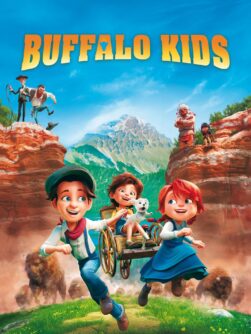
BUFFALO KIDS
Two orphaned siblings, a scrappy dog, and a heart that carries the whole thing home.
Should You Watch It?
Here's the good news up front: this is a genuinely moving little film. Two Irish siblings, orphaned and adrift in 1800s America, set out to cross a continent to find the only family they have left — and along the way they choose kindness at every turn, especially toward a disabled boy the other children write off. That tenderness is the heart of the movie, and it beats strong.
The animation isn't always top-tier, and the source is honest about that. But the love between the characters carries what the visuals sometimes can't, and the result is heartfelt rather than slick.
Parents should know it earns its caution. There's real peril, a kidnapping, cartoon action violence, and a bit of minor language. For older children who can weather danger on screen, this is a rewarding, wholesome adventure worth settling in for.
The Story
NO SPOILERS — WE KEEP THE SURPRISESTom and Mary have lost their parents. They arrive in New York City to meet an uncle who isn't there — and who, it turns out, lives all the way across the country in Sacramento, California.
With no American money and no way to buy train tickets, the resourceful siblings — and a little white dog named Sparky — find themselves swept in among a chaotic group of westbound orphans. On that train they meet Nick, a disabled boy the other children call "weird," and his devoted caretaker. What begins as a desperate journey home is about to become a real adventure.
Is It Any Good?
Three stars, and the source is candid about where they come from. The animation isn't always strong — this isn't a studio spectacle, and the visuals occasionally show it. What the film has instead is a beating heart.
The love between these characters is the thing that works, and it works so well it lifts the whole movie. Mary's tenderness toward Nick, the siblings' fierce loyalty to each other, the surprising friendships forged through hardship — these land emotionally in a way polish alone never could. The second half tips into full western-adventure mode, with coyotes, cavalry, and a gold mine, and the story goes a little "off the rails" there by the source's own account. But the film builds toward a genuinely beautiful ending. Remarkable and heartfelt is the verdict, and it's fair.
The Worldview
This is a film with a strong Christian worldview, even though faith is never named or discussed out loud. Instead, it preaches through action: kindness, compassion, mercy, generosity, self-sacrifice, honoring one's parents, and the rebuking of evil are all lived out by the children at the center.
What the movie exalts most is the dignity of the overlooked. The disabled boy, Nick, is never treated as a burden or a background figure — the siblings insist he experience every part of the adventure as an equal. That instinct is the film's moral spine, and it stands in sharp contrast to the villain, a greedy man with no regard for human life who declares a disabled child useless and says to "get rid of him." The film lets us feel the full weight of that evil precisely so we recognize it as evil.
There's a deeper truth here too, the source notes: never underestimate a child, or the wonder that carries children through disaster. The story also has its characters push past racism and adversity toward a greater good, forming friendships no one expects.
Underneath it all is the ache of orphaned children longing for home and family — an ache Scripture answers directly: "God settles the solitary in a home" (Psalm 68:6).
The Content Guide
The specifics — spoilers included by nature — so you can judge for your own family.
Dominant Worldview and Other Worldview Content/Elements
A strong Christian worldview, even though religion is not expressed or discussed outright. Christian principles are strongly displayed through the main characters including kindness, compassion, mercy, generosity, unselfish, honoring parents and rebuking evil. Even in their grief of the loss of their parents and now finding themselves in a new country, the siblings work to protect each other and a disabled child. The disabled character allows the siblings’ true hearts shine through, always ensuring that he is experiencing every part of the adventure with them as an equal. The premise relies on children overcoming many obstacles – including financial struggle, kidnapping, and basic survival, often in dangerous situations, especially given the time period. However, the story reveals a deeper truth about not underestimating a child and the depths of their wonder seeing them through disaster. The antagonists are evil with no regard for human life or suffering in pursuit of money for themselves. The children develop surprising friendships through adversity and racism towards a greater good. Throughout this adventure, the pieces begin to build together form a uniquely beautiful ending
Foul Language
Three obscenities, including two uses of the “D” word, one use of d*mnit. Scatological humor with characters farting and running to the bathroom
Violence
Cartoon action violence and peril as characters are often in dangerous situations, such as falling/almost falling over cliffs, running on trains, falling/almost falling. Coyote attacks in several scenes. Hand-to-hand combat and guns drawn. Bandits attack a train and take the passengers prisoner. Prisoners are whipped and threatened. The villain often talks of “getting rid of” people
Sex
No sex or sexual reference. The children shyly show romantic interest. A man and a woman flirt. A man grabs and kisses a woman while celebrating
Nudity
No nudity
Alcohol Use
A man drinks from a flask and says, “it may be time to quit”, implying it is alcohol, but is later revealed to be coffee. Another man drinks from a flask
Smoking and/or Drug Use and Abuse
No smoking or drug use;
Miscellaneous Immorality
Orphaned siblings are abandoned suggesting bad role models and sowing mistrust, however there is more to be revealed. Kidnapping, including children. Bandits attack a train and take passengers prisoner. Prejudice towards Native Americans, especially when the bandits leave arrows behind after they raid the train. The villain is greedy and rude, pushing for more profit and working prisoners to death. Feeling that a disabled child is no use to him, he says to just “get rid of him,” holding no value of human life. They plan to blow up the mine and the prisoners, leaving no trace.
Talk About It
Questions for the drive home, the dinner table, or the youth group.
The other children call Nick "the weird kid," but Mary and Tom treat him as an equal and make sure he shares in every part of the adventure. How does God call us to treat those the world overlooks?
James 2:1–4 · Luke 14:13–14The villain says a disabled child is useless and should be "gotten rid of." Where does the true value of a human life come from — and how does that truth answer him?
Genesis 1:27 · Psalm 139:13–16Tom and Mary lose their parents and cross a whole country searching for family. What does the Bible promise to those who feel alone and without a home?
Psalm 68:5–6 · John 14:18The children push past racism and hardship to build unlikely friendships for a greater good. What does it take to love someone who is very different from you?
Luke 10:33–37 · Colossians 3:11The Final Word
This is a small film with a big heart — imperfectly drawn, but honest and tender, and built on exactly the virtues we want our children to catch. The danger and the kidnapping storyline mean the youngest ones may find it too much, but for older kids ready for adventure with real stakes, it's a lovely watch. Our answer stands: worth the trip — ages 8 and up.