BOSTON STRANGLER
Two women, one serial killer, and a story worth telling — for grown-ups.
Should You Watch It?
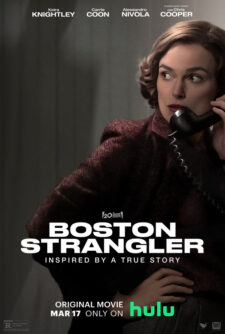
Here's the decision. This is a well-made, fast-moving thriller built on a true story worth telling: two women reporters in 1963 chasing a serial killer the police kept missing. The film honors justice, honors dogged truth-telling, and mostly keeps its violence off-screen — heard through a neighbor's wall rather than shown.
But it earns its R. The subject is a man strangling women, and the movie doesn't pretend otherwise. There's strong violence in the scenes it does depict, sexual assault discussed if not shown, seventeen obscenities including two "f" words, and three strong misuses of the name of Jesus. The killer's method is, by design, disturbing.
So: if you're an adult drawn to true crime and can weather hard material without harm to your conscience, this is worth your time — and it plays best at home, where you set the terms. If you're choosing for children or teens, choose something else.
The Story
NO SPOILERS — WE KEEP THE SURPRISESBoston, 1963. Loretta McLaughlin, a reporter stuck writing fashion columns and kitchen-gadget reviews, notices a pattern: three women strangled across the city, each murder eerily alike. She fights to cover the story — and her first byline, "Mad Strangler Loose," lands like a grenade.
City leaders want it buried. Her editor kills it. Then another victim turns up. As Loretta and her colleague Jean pull the threads the police left dangling, the story stops being a story — and the danger comes home. What they finally uncover, we'll leave to you.
Is It Any Good?
Three stars, and here's what earns them. The plot moves fast from the first frame to the last, and the film builds a genuine, mounting tension as Loretta closes in. Keira Knightley and Carrie Coon anchor it as two reporters fighting the story and their own newsroom at once.
The craft choice that both helps and hurts is the look. The cinematography is faithful to the 1960s — deliberate light and shadow, single-camera framing that puts you in the era. But it's often too dark, and more than a few scenes are simply hard to make out. Credit, too, the director's restraint: he leans on period photographs to convey the horror of the crimes rather than staging them, which keeps the violence powerful without becoming gratuitous. A strong film held just short of great by its own murk.
The Worldview
At its core this is a moral film. Loretta and Jean want one thing above all: justice for women no one else was fighting for. That pursuit — truth dug out and brought to light, the vulnerable defended — is the film's engine, and it's an honorable one, even as the movie honestly admits that two copycat killers escape the reckoning they deserve.
Running alongside is a feminist thread. The film portrays the real sexism of the 1960s newsroom — male reporters belittling the women, downplaying their work — and follows Loretta as she risks her career and her marriage to break through it. You can affirm the dignity and courage on display while weighing how the film frames the fight; both readings sit in the movie at once. There's also a brief grace note: a church scene with a choir singing.
What the story finally chases is what Scripture chases — justice for the defenseless, evil dragged out of the dark. But the film can name the longing better than it can satisfy it. When the copycats walk free, the ache for a final accounting remains. Scripture answers it: "He has fixed a day on which he will judge the world in righteousness" (Acts 17:31).
The Content Guide
The specifics — spoilers included by nature — so you can judge for your own family.
Dominant Worldview and Other Worldview Content/Elements
Strong moral worldview of justice as the ultimate ideal (though two copycat murderers get away with their crimes), with secondary feminist elements where the main character breaks down walls for women to work in the field of journalism, plus there’s a scene set in a church with a choir singing
Foul Language
17 obscenities (including two “f” words), three strong Jesus profanities, one light profanity
Violence
Strong violence includes several scenes of a man strangling a woman (one depicted, several overheard and implied), three scenes of police pointing guns in a crime scene (they don’t shoot them), a man is stabbed to death, several scenes of police photographs of victims tied up with a stocking tied around their neck
Sex
Light sexual content includes several depictions of a married couple kissing, several scenes of police discussing sexual assault (not depicted), and a man slides his hands up woman’s skirt
Nudity
No explicit nudity but there are photos of victims wearing only bras and underwear
Alcohol Use
Four scenes with alcohol use
Smoking and/or Drug Use and Abuse
Several scenes of smoking, but no drugs;
Miscellaneous Immorality
Strong miscellaneous immorality includes stealing, greed, revenge, dysfunctional family dynamics, some bad role models, and male reporters insult female reporters, downplaying their efforts and abilities.
Talk About It
Questions for the drive home, the dinner table, or the youth group.
Loretta risks her job, her safety, and her marriage to bring the truth to light. When is truth-telling worth that kind of cost — and when does zeal for the story crowd out other duties?
Proverbs 31:8–9 · Ephesians 4:15The film's great grievance is that some killers escape justice on earth. How does the hope of a final, righteous judgment change the way we carry unresolved injustice?
Acts 17:31 · Romans 12:19The newsroom treats Loretta and Jean as less capable because they're women. How should we see the dignity and gifts of the people others overlook?
Genesis 1:27 · Galatians 3:28This is a story about evil done in secret and dragged into the light. What does Scripture say about what stays hidden — and what doesn't?
Luke 8:17 · Ephesians 5:11The Final Word
This is a serious, well-acted thriller about two women who refused to let a story — or a killer — stay buried, and it honors the pursuit of justice. It's also dark in every sense, with strong violence and profanity built around disturbing crimes. So our answer stands: wait for home — adults only, where you control the room. Looking for something the whole family can watch instead? Start with our family-friendly picks.