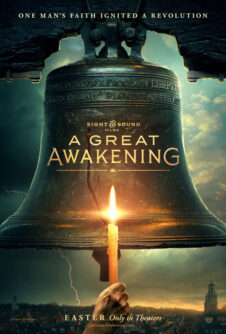
A GREAT AWAKENING
A rousing, faith-filled history lesson — for teens and up, not little ones.
Should You Watch It?
Yes — especially if your family loves history. This is a rare film that treats the Great Awakening, and the preacher George Whitefield, as the hinge on which American independence actually turned. It's well cast, well directed, and full of dramatic conflict, and it makes a genuinely persuasive case that revival — not just politics — built the United States.
It earns its caution honestly. Younger children may be bothered by Whitefield's scarred eye and the beatings he endures, and there's a bawdy theater scene with a strong sexual reference that has no business near little eyes. Franklin's persistent challenges to Whitefield's faith are also part of the story, though they're answered rather than left standing.
For teens and adults, though, this is exactly the kind of film Movieguide wants to see more of: historically grounded, spiritually serious, and dramatically alive. Take the older kids. Leave the little ones home.
The Story
NO SPOILERS — WE KEEP THE SURPRISESAs the Constitutional Convention stalls in bitter deadlock, an aging Benjamin Franklin retreats to his grandson's print shop and pulls out an old box: the journals of his late friend George Whitefield, the itinerant preacher whose sermons once electrified a continent. The film flashes back to trace both men's unlikely paths — Whitefield's from a mocked, disfigured boy to the most powerful voice in the British Empire; Franklin's from a rebellious printer's son to America's shrewdest businessman. Their friendship, and their argument, will shape a nation. We'll leave the convention floor for you to discover.
Is It Any Good?
Four stars, and they're earned. The acting — particularly John Paul Sneed and Jonathan Blair as Whitefield and Franklin — is excellent, and excellent acting is usually a sign of strong directing underneath it. The film is dense with jeopardy and dramatic conflict, and its dialogue is genuinely well written.
It also breaks a screenwriting rule and gets away with it: the movie is built almost entirely on flashbacks, which conventional wisdom says drains momentum. Here, the strength of the scenes and the sharpness of the writing carry the structure anyway. This is, by the source's own estimation, one of the best and most dramatic historical films made — a rare case where craft matches conviction.
The Worldview
This film exalts what Scripture exalts: revival, humility, and the sovereignty of God over nations. Whitefield's most striking line comes when confronted with his own flaws — "My character is flawed; so, look at Jesus, not me." That's a worldview rightly ordered, and the film builds its whole argument around it: that the Great Awakening, not merely political philosophy, produced the moral seriousness that made American independence and its Constitution possible.
The film is honest about the cost of that faith and the resistance to it. Whitefield is mocked, beaten, and pelted with rocks and bottles for preaching, and clergy who are "dead to Christ" are called out by name in the story. Franklin, meanwhile, stands as faith's friendly opposition — a confirmed atheist who challenges Whitefield at every turn, only to be moved by him in the end. The film doesn't flinch from human frailty either: Whitefield's own orphanage employed slaves, and the movie lets that contradiction stand rather than smoothing it over.
The ache underneath this story is the ache every founding generation feels — the hunger for a nation ordered by something greater than its own arguments. Scripture names the source of that order plainly: "Righteousness exalts a nation, but sin is a reproach to any people" (Proverbs 14:34).
The Content Guide
The specifics — spoilers included by nature — so you can judge for your own family.
Dominant Worldview and Other Worldview Content/Elements
Extremely Christian, historically accurate, moral, entertaining, patriotic presentation of the influence of The Great Awakening on the Constitutional Convention, driven by the friendly opposition of George Whitefield [“Wit-field”], a man of great faith, and Ben Franklin, a confirmed atheist with a surprising ending, and Whitefield prays that people don’t look at him but look at God, plus characters run profitable businesses
Foul Language
No foul language
Violence
A school master, parents and fellow students somewhat violently abuse Whitefield because he has one eye that has a film over it, prisoners are shown in horrible shackles, several scenes where people attack Whitefield with rocks and bottles and other things when he’s preaching, Franklin in one scene suggests that Whitefield grab the key from the wire to the kite and says he had his son do that and the lightning went into his hands
Sex
Franklin as an ambassador to England and then France is watching a bawdy play mocking Whitefield with a strong sexual reference while a woman next to Franklin puts her hand on his thigh, and an English admiral asks Franklin what his wife thinks about his female dalliances
Nudity
Bawdy costumes highlighting female and male attributes, and prisoners in tattered clothes
Alcohol Use
Franklin’s mother works at a bar which has a stage where people are constantly drinking
Smoking and/or Drug Use and Abuse
No smoking or drugs;
Miscellaneous Immorality
People mock the Gospel, Franklin constantly challenges Whitefield’s faith, telling him God is unnecessary, Franklin points out that Whitefield’s orphanage in Georgia uses slaves but Whitefield says, “My character is flawed; so, look at Jesus, not me,” and other examples of human frailty.
Talk About It
Questions for the drive home, the dinner table, or the youth group.
Whitefield tells Franklin, "My character is flawed; so, look at Jesus, not me." Why is it important to separate a messenger's failures from the truth of the message?
2 Corinthians 4:7 · Romans 3:23Franklin challenges Whitefield's faith throughout the film, yet is deeply moved by him in the end. What does real friendship across deep disagreement look like in your own life?
Proverbs 27:17 · 1 Peter 3:15The film argues that spiritual revival, not just politics, made American independence possible. Do you think a nation's character shapes its laws — or the other way around?
Proverbs 14:34Whitefield keeps preaching even after being bloodied by rock-throwing crowds. What gives someone the courage to keep going when the cost is real?
2 Timothy 4:5 · Hebrews 12:1–2The Final Word
Movies this thoughtful about the roots of American liberty don't come around often, and this one earns its four stars honestly — sharp performances, real stakes, and a faith at its center that isn't decoration but the whole point. It's simply not a film for little children. For everyone else, our answer is the same one we opened with: worth the trip — teens and up.