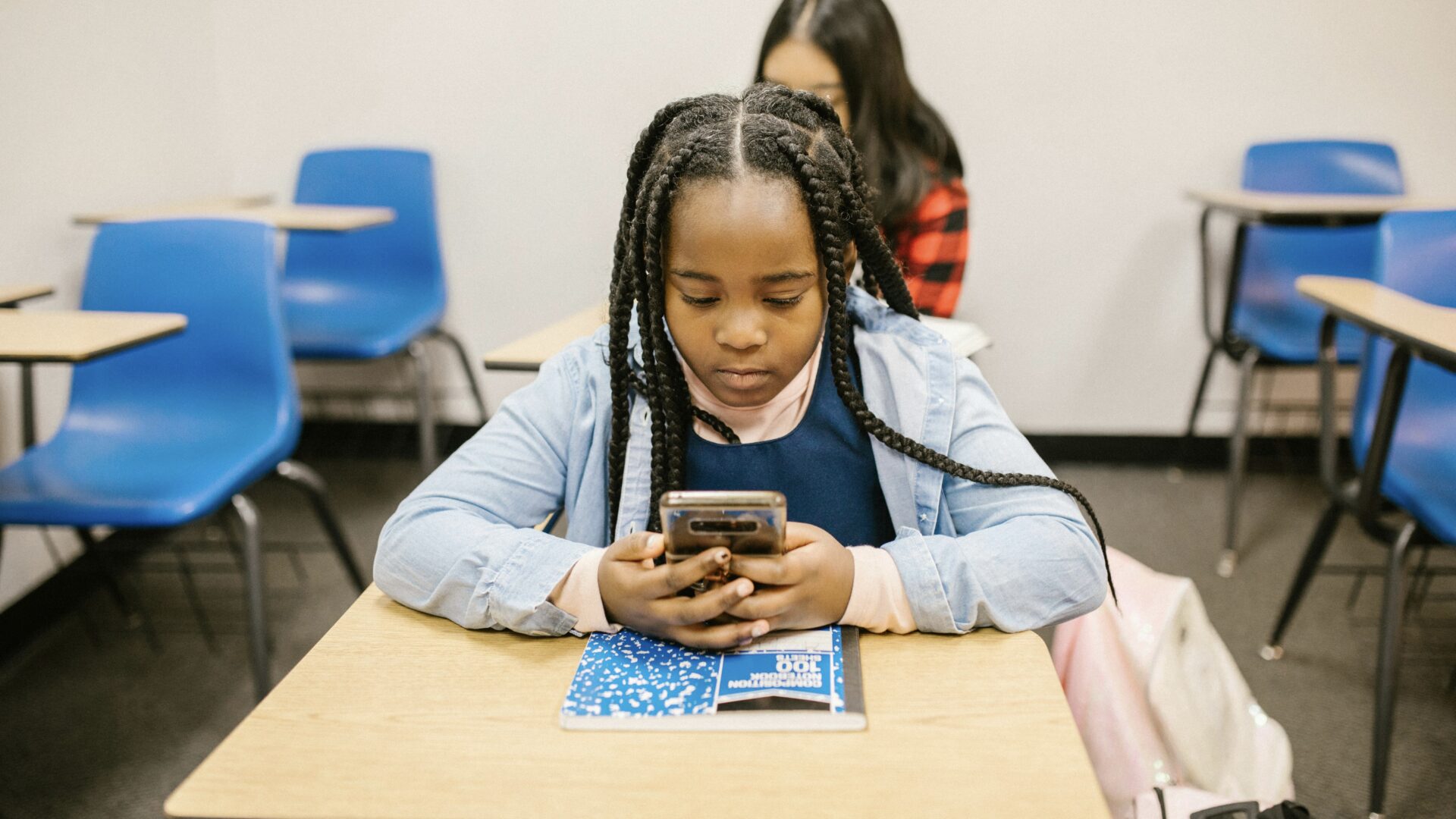
Owning a cell phone might be quietly working against your child’s reading skills — and it has nothing to do with sneaking peeks at it during class.
“We found that there’s no age at which you can give a child a phone that’s better or worse for reading comprehension, so it’s just having a phone at all,” Patricia Greenfield, a professor of psychology at UCLA and lead author of the study, told UCLA Newsroom.
Greenfield and her co-authors — Marola Hanna, Rocio Burgos-Calvillo and Laura Rhinehart — set out to measure how phone ownership affects reading comprehension in more than 100 third and sixth graders across Los Angeles County public and Coptic Church schools. Their study, published July 23 in the journal Behavioral Sciences, found that kids who owned phones scored lower on reading comprehension tests than kids who didn’t, no matter how old they were when they got the phone.
That finding surprised the researchers for one particular reason: it wasn’t about distraction. Reading tests looked nearly identical whether a child’s phone was sitting on the desk or locked away at home, 89% correct with the phone present versus 87% without it — a gap too small to matter statistically. One participant, a 19-year-old who took part in an earlier phase of the research, put it more bluntly: “Nobody looks at their phone when they are taking a test.”
Related: Is Your Screen Time Affecting Your Kids? Experts Say Yes.
So if it’s not the phone buzzing in a kid’s pocket during a quiz, what’s going on?
Greenfield’s team thinks ownership itself changes how children spend their time and attention outside the classroom — texting, gaming, scrolling — in ways that quietly crowd out the sustained reading that builds comprehension. Interestingly, the study found one bright exception: sixth graders from non-English-speaking homes who started texting earlier actually scored better on reading tests, suggesting texting may double as language practice for bilingual kids juggling two vocabularies at once.
It’s a nuance worth sitting with, because Movieguide® has covered this territory before, and not always with a doom-and-gloom conclusion. Last year, Movieguide® reported on a University of South Florida study that found smartphone ownership correlated with lower rates of depression and anxiety in some teens, with USF associate professor of psychology Wendy Rote noting that “it’s what kids do with cell phones…rather than merely owning a smartphone” that determines the outcome. Taken together with the new UCLA research, the picture that emerges isn’t “phones are evil” — it’s that ownership reshapes daily habits in ways parents need to watch closely, especially when it comes to something as foundational as reading.
For Christian families, that’s a familiar lesson wearing new data: what we hand our kids shapes what they become, and a phone is no exception. Scripture never mentions smartphones, obviously, but its repeated calls to guard a child’s habits and train up their attention apply just as well to a glowing screen as to anything else competing for a young mind. Parents don’t need to panic over one study, but it’s one more concrete, non-hysterical reason to keep pushing books into small hands before, or alongside, the phone.
Movieguide® has long tracked how screens are reshaping childhood, from screen time limits to why kids are swapping TV for gaming and video. This latest research adds reading comprehension to that list and gives parents one more reason to keep the phone on a short leash, at least until the last page is turned.
Read Next: How Smartphones Are ‘Destroying’ Your Child’s Ability to Focus
Questions or comments? Please write to us here.