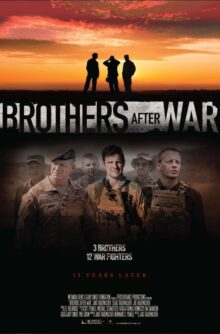
BROTHERS AFTER WAR
A raw, hopeful listening session with the veterans among us.
Should You Watch It?
Here is the decision. Jake Rademacher's follow-up to his 2009 documentary BROTHERS AT WAR is a much-needed film — one that shows, more honestly than most media or fiction manage, the toll that war and military service take on soldiers and the families waiting at home. It listens. And the stories it gathers, raw as they are, point toward hope and healing.
It also earns its R rating. There are a few strong obscenities and profanities. The war violence is brief but very strong, with blood and graphic loss of limbs. And the film speaks plainly about PTSD, suicidal thoughts, and veterans who sought solace in alcohol and drugs. This is not a movie for children.
So: if you are an older teen or an adult ready to sit with hard truths and honor the people who lived them, go. This one asks you to listen — and it's worth the listening.
The Story
NO SPOILERS — WE KEEP THE SURPRISESJake Rademacher has spent his life in and around the military, and helping veterans readjust to civilian life. In this documentary he takes viewers on a journey, interviewing his own brothers and nephew alongside veterans from every branch — Army, Navy, Marines, Air Force, infantry, and special forces.
He talks to the soldiers, and he talks to their wives and children. What does deployment do to a marriage? To a kid who has to relearn a parent? To a man who came home carrying what he saw? The interviews open a door most of us rarely walk through.
Is It Any Good?
Three stars, and here is what they mean. BROTHERS AFTER WAR earns them on the strength of its stories — powerful, raw, emotional, and often uplifting. When wives describe raising children practically alone while fearing for their husbands, or veterans describe the dark places they fell into and the long climb back, the film lands with a weight fiction struggles to reach.
It isn't flawless. There are editing errors and recording issues that a tighter production would have caught, and they occasionally pull you out of the moment. But the substance holds. This is a well-structured, deeply human documentary that knows what it's for — and does it. The rough edges keep it from a fourth star, not from being worth your time.
The Worldview
BROTHERS AFTER WAR carries a strong moral and patriotic worldview. It honors American military veterans and their families, and it refuses to look away from what they endure — the after-effects of violence, physical recovery, mental health, suicidal thoughts, the strain on marriages and children. Director Jake Rademacher's whole mission is to answer that darkness with light: to let people tell their stories, to press toward support, therapy, and healing, and to show veterans that their communities need to listen to them.
Much of what the film exalts is what Scripture exalts — compassion for the suffering, the bearing of one another's burdens, the pursuit of a more abundant life for the wounded. It shows the love and care our soldiers and their families deserve.
Regrettably, the film keeps all of this in a purely human frame. It avoids putting any of these struggles in a religious context, and there is no religious content to speak of. That's a real absence: the hope it reaches for has no anchor beyond human effort. The healing it longs to give is exactly the kind Scripture promises can go deeper — "He heals the brokenhearted and binds up their wounds" (Psalm 147:3).
The Content Guide
The specifics — spoilers included by nature — so you can judge for your own family.
Dominant Worldview and Other Worldview Content/Elements
Strong moral and patriotic worldview, but with no religious content, honors American military veterans and their families while trying to bring hope and healing to them, with many soldiers and veterans talking about how much they struggle to process the horrors and hardships of war and survival, some of the veterans end up in really dark places, but the Director Jake Rademacher’s whole mission throughout the movie seems to combat this by having a variety of people share their stories and the hardships of the military life can have, and the toll the hardships take on them, soldiers and wives and children tell stories of heartbreaking and hopeful situations, plus movie stresses bringing hope and promotes helpful therapy
Foul Language
Two people use “f” words two or three times each, and two soldiers utter two strong profanities using the name of Jesus
Violence
Brief but very strong violence and some other violence includes moments where soldiers are shooting at people and cars (sometimes at dummies and sometimes at real people), blood is shown with wounded soldiers, people are shown in a few instances with a graphic loss of limbs, and suicide is also mentioned numerous times by different people.
Sex
No sex
Nudity
No nudity
Alcohol Use
Implied use and abuse of alcohol is discussed by numerous vets but never shown and never talked about positively
Smoking and/or Drug Use and Abuse
No depicted smoking or drug use, but veterans talk about sometimes seeking solace in drugs;
Miscellaneous Immorality
Director admits to being divorced as do a few of the people he interviews.
Talk About It
Questions for the drive home, the dinner table, or the youth group.
The wives in this film carry enormous burdens — parenting alone, waiting, fearing. How can a church community actually help a family whose loved one is deployed or struggling?
Galatians 6:2 · James 1:27Many veterans here fell into dark places, and some sought escape in alcohol or drugs. Where does lasting comfort come from when the weight feels unbearable?
2 Corinthians 1:3–4 · Matthew 11:28The film longs for healing but keeps it in a purely human frame. What does Scripture add to the healing of the brokenhearted that therapy alone cannot?
Psalm 147:3 · Psalm 34:18The title asks us to listen to our veterans. Who in your life is carrying something quietly, and what would it look like to truly listen this week?
James 1:19 · Romans 12:15The Final Word
Jake Rademacher has made something our country needs: an honest, uplifting look at what war costs the people who serve and the families who wait. It's rough around the edges and heavy in its subject matter, but it listens where most of us look away. So here is our answer, the same one we opened with: worth the trip — adults only. Looking for something the whole family can share instead? Try our latest family-friendly picks.