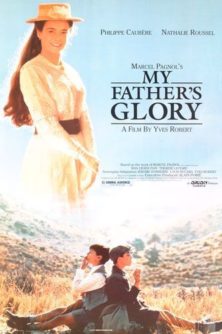
MY FATHER’S GLORY
A tender Provençal remembrance of family, faith, and a father's humanity.
Should You Watch It?
If you value quiet films that find meaning in ordinary family memories, this is worth your time. The movie is warm, lively, and affectionate without ignoring the weaknesses and contradictions within a family. Its strongest achievement is the way a boy comes to see his father not merely as a figure of glory, but as a complicated man.
The film also invites reflection on the difference between scientific humanism and belief in God. Christians may appreciate its love of family and its attention to life's small blessings while grieving that its central humanist perspective does not arrive at knowledge of the Creator.
For a gentle, beautifully made family drama with spiritual questions worth discussing, choose WORTH THE TRIP.
The Story
NO SPOILERS — WE KEEP THE SURPRISESYoung Marcel Pagnol spends part of his childhood in the mountains of Provence with his family. Away from ordinary life, he stretches his independence, discovers the countryside, and develops a deeper understanding of his father.
The story gathers its meaning from small experiences: family conversations, outdoor adventures, and the memories that remain vivid long after childhood has passed.
Is It Any Good?
Three stars means this is a very good film whose exceptional qualities make it memorable. The cinematography beautifully captures the countryside of Provence, while the lighting, setting, and visual style resemble an Impressionist painting.
The musical score is fitting and enriched by sounds associated with Provence, including breezes, birds, and the sea. The performances are wonderful, especially Julien Ciamaca as Marcel and Philippe Caubere as his father. The film's regional language and dialect also contribute to its emotional power.
The Worldview
The film presents Marcel's childhood through a fond, sometimes sardonic remembrance. It values family love, the beauty of nature, the importance of small moments, and the deepening bond between a son and his father. Marcel's mother offers him a spiritual understanding of life, while his father emphasizes science, human reason, and the hope that knowledge can bring joy to the poor and humble.
The source's worldview analysis identifies Pagnol as a humanist with an unusually broad understanding of people and the natural world. That knowledge is treated as incomplete because it does not include knowing the Creator personally. The film's human warmth is genuine, but its perspective does not reach the wisdom that comes from relationship with the sovereign God who became flesh.
The depiction of Marcel's mother is also notable. She is presented as a loving, active woman who invites her son to dream and discover life's meaning, rather than being reduced to a maternal role. This warm characterization contrasts with portrayals that treat women as sex objects.
The film's longing for glory finds its fullest answer beyond human achievement: “we all, who with unveiled faces contemplate the Lord’s glory, are being transformed into his image with ever-increasing glory” (2 Corinthians 3:18, NIV).
The Content Guide
The specifics — spoilers included by nature — so you can judge for your own family.
Content Summary
Nude little boys washing outside (but presented in an innocent, inoffensive manner) and mother's breast while breast-feeding (presentation, here, too, is in a natural, not offensive style)
Talk About It
Questions for the drive home, the dinner table, or the youth group.
Marcel learns to see his father beyond boyish wonder, including his weaknesses and contradictions. How can love help us see our parents truthfully and generously?
1 Corinthians 13:4–7 · Ephesians 6:2–3Marcel's parents offer different ways of understanding the world: scientific knowledge and spiritual faith. How can Christians pursue knowledge while still honoring God as Creator?
Proverbs 1:7 · Romans 1:20The story treasures small experiences and ordinary family moments. What simple moments in your family do you hope to remember?
Psalm 90:12 · Philippians 4:8Marcel speaks of raising his father's glory, while Christians look to the glory of God revealed in Christ. What is the difference between honoring a person and worshiping God?
1 Corinthians 10:31 · 2 Corinthians 3:18The Final Word
This is a warm, beautifully crafted remembrance of childhood, family love, and a son's growing understanding of his father. Its humanism leaves an important spiritual question open, but its affection and artistry are genuine. For thoughtful viewers and families, WORTH THE TRIP.