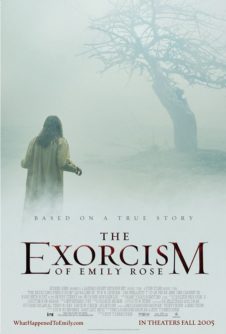
THE EXORCISM OF EMILY ROSE
A compelling supernatural trial drama for older teens and adults.
Should You Watch It?
This is a scary, dramatically compelling courtroom drama with a strong Christian worldview. Its talented cast, atmospheric exposition, and impressive cinematography give weight to a story that could otherwise feel hokey: an agnostic lawyer defends a priest accused after a young woman's death during an exorcism.
The movie treats Christian faith seriously. It presents scientific and humanist explanations for Emily's experiences, but usually gives a solid pro-Christian interpretation as well. It also leaves some room for doubt, especially at the end, inviting viewers to think and discuss rather than handing them a simple answer.
The fear is the deciding factor for families. The possession and exorcism scenes are realistically done, but they are too scary for children and young teenagers. Older teens and adults who can handle supernatural horror may find this worth seeing; families with younger or impressionable viewers should choose something else.
The Story
NO SPOILERS — WE KEEP THE SURPRISESInspired by a true story occurring in Bavaria in 1976, the film follows the trial of Father Richard Moore, a Catholic priest who performed a controversial exorcism.
Erin Bruner, an ambitious agnostic lawyer, defends him. To make the case, she presents evidence that Emily Rose may really have been possessed while countering the prosecutor's argument that Emily suffered from epileptic seizures. Eventually, Father Moore takes the stand to tell Emily's story from his own point of view.
Is It Any Good?
Three stars means this is a very good, though imperfect, supernatural courtroom drama. The talented cast carries the material well. Tom Wilkinson gives a powerful performance as a strong, compassionate, and thoughtful Christian leader, while Laura Linney and Campbell Scott are outstanding as the opposing attorneys.
The atmospheric exposition and impressive cinematography strengthen the film. The flashbacks at a trial could have been a hokey storytelling device, but the movie remains dramatically compelling despite that potentially awkward structure.
The Worldview
The film presents a strong Christian worldview in a Roman Catholic setting. Characters quote Scripture and refer to Jesus Christ. The story takes Christian claims about the supernatural seriously while also presenting scientific and humanist explanations for Emily's experiences. A vision of the Virgin Mary and other spiritual phenomena are treated within the film's Catholic framework, though alternative explanations remain part of the discussion.
The movie generally offers a solid pro-Christian interpretation of events. It does not give demonic forces too much power and eventually suggests that God is ultimately in control. Still, the ending leaves room for doubt, especially because the defense attorney offers an emotional reason for acquitting the priest rather than a conclusive resolution.
The film's central debate is not simply science versus faith. It asks how human beings should weigh evidence when the mind, the body, and the spiritual world seem to overlap. That question can lead to wise discussion, provided viewers test ideas carefully: “Test everything; hold fast what is good” (1 Thessalonians 5:21).
The Content Guide
The specifics — spoilers included by nature — so you can judge for your own family.
Content Summary
Strong Christian worldview in a Roman Catholic setting, with strong biblical content, mitigated somewhat by some humanist content and arguments about science and faith by the antagonist (who is a Methodist) and one of the protagonists (who is an agnostic), and exorcism patient has a vision of the Virgin Mary and receives stigmata on her hands, but a humanist explanation is offered for her wounds, as well as occult manifestations and apparitions are identified variously as demonic activity or psychotic experiences; three obscenities and three light profanities; strong, often scary violence such as demons spook people and horses, demon attacks young woman several times, many bruises on face of corpse are shown in a photo, demons possess young woman, possessed young woman jumps through window and contorts her body, car accidentally hits man in street, young woman receives bloody stigmata on her palms, and men try to hold down possessed young woman to stop her from hurting herself; no sex or nudity; alcohol use; smoking; and, anthropological and psychological explanations given for spiritual phenomena (one of which may be slightly New Age) and boss threatens to fire attorney if she uses particular defense for her client.
Talk About It
Questions for the drive home, the dinner table, or the youth group.
The film places scientific and spiritual explanations side by side. How should Christians respond when they encounter claims they do not immediately understand?
1 Thessalonians 5:21 · Proverbs 18:17The story asks whether suffering can have spiritual dimensions. What does Scripture say about spiritual conflict, and why should Christians remain sober-minded?
Ephesians 6:12 · 1 Peter 5:8The film suggests that God is ultimately in control. How does that truth change the way we face frightening or confusing circumstances?
Psalm 46:1–2 · Romans 8:38–39Erin Bruner must defend a position that challenges her own assumptions. How can Christians listen carefully while still holding fast to truth?
James 1:19 · Acts 17:11The Final Word
This is a well-acted, atmospheric, and thought-provoking supernatural drama with a strong Christian perspective. Its frightening scenes make it unsuitable for children and young teenagers, but older teens and adults may find it worth discussing. Our answer is WORTH THE TRIP — OLDER TEENS AND ADULTS.