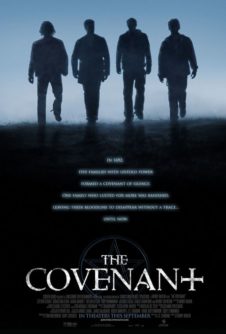
THE COVENANT
Dimwitted, lackluster occultism makes this a clear skip.
Should You Watch It?
You should skip The Covenant. Its characters are lackluster, its storytelling is choppy and confusing, and the explanation of its magical powers takes too long to make sense. Even then, important questions about those powers remain unanswered.
The bigger problem is the film’s very strong occult worldview. Magical powers appear without explanation, and although using them carries danger, the hero eventually must use them to fight a villain who harms and kills others. The content also includes strong violence, profanity, nudity, smoking, and other concerns.
The practical answer is simple: skip The Covenant.
The Story
NO SPOILERS — WE KEEP THE SURPRISESFive European families once fled persecution in Europe for New England. The first-born males in each family receive magical powers at ages 13 and 18, though using those powers carries a terrible danger.
In the present, Chase, an unknown heir to the fifth family, threatens four teenage heirs and two of their girlfriends. Caleb, who is about to turn 18, must find a way to stop him.
Is It Any Good?
One star means this film offers little entertainment value. The characters are lackluster, and the movie is choppy, sloppy, and confusing, especially in its first half.
The exposition about the magical powers takes a long time to become understandable. Even after that, the story remains confusing, and the reason behind the powers is never revealed. The film’s allegorical Christian metaphors about Caleb and his father provide some meaningful material toward the end, but they do not overcome the weak filmmaking.
The Worldview
The Covenant presents a very strong occult worldview centered on first-born sons receiving magical powers. These powers appear out of nowhere and include levitation, energy attacks, spying, and death spells. The characters do not call them witchcraft, despite using an occult circle to consult The Book of Damnation. The book and its purpose are not clearly explained.
The film does include a warning about power. Its hero repeatedly cautions his friends about using their abilities, and the story shows that power can become addictive and destructive. Yet the hero ultimately uses the same kind of power to oppose a villain who uses it to harm and kill others. The movie also revises the history of the persecution of witches in Europe and Massachusetts.
Toward the end, the story between Caleb and his father contains allegorical Christian metaphors. Still, the film’s central framework treats magical power as something available to human beings, rather than presenting a biblical view of dependence on God. Scripture warns, “Desire when it has conceived gives birth to sin” (James 1:15).
The Content Guide
The specifics — spoilers included by nature — so you can judge for your own family.
Content Summary
Very strong occult worldview about the first-born sons of five American families in New England getting magical powers at age 13 and 18 to levitate, fire energy bombs and bolts at people, spy on people, and cast death spells that appear as tiny spiders, plus some revisionist history about the truth behind the persecution of witches in Europe and Massachusetts, some moral elements, and allegorical Christian metaphors about the hero and his father; 16 obscenities, two light profanities and teenagers uses magical powers to make another teenager throw up in order to stop a fight; strong action and scary violence, such as teenage boys use magical powers to fire energy bombs and bolts at one another, speeding truck demolishes teenager’s speeding car and teenager immediately uses magical powers to re-form his car, boys use magical power to hurtle each other against walls and objects, boys use magical powers to hit each other with objects, villain uses magical powers to cast deadly sickness spells on girlfriends of two of his rivals, teenager uses magical powers to create fireball, scary dreams and visions with dead people, two spiders crawl on two girls’ faces, and lots of spiders crawl around room; no sex, but some kissing and invisible boy spies on girl in showers; obscured rear female nudity behind shower door, upper and rear male nudity in locker room and girls in underwear; implied teenage alcohol use at rave party; smoking; and, teenage boys with magical powers pull a few pranks and teenagers hold illegal party and run from police when they appear.
Talk About It
Questions for the drive home, the dinner table, or the youth group.
The film presents magical power as both dangerous and useful. What does Scripture teach about the danger of pursuing power apart from God?
Deuteronomy 18:10–12 · James 1:15The hero warns his friends against using their powers but eventually uses them himself. How should Christians respond when they are tempted to use a wrong method for a seemingly right goal?
Romans 3:8 · 1 Thessalonians 5:21–22The story includes allegorical Christian metaphors about a hero and his father. What makes a father’s relationship with his child healthy and trustworthy?
Ephesians 6:4 · Colossians 3:21The film invents a new account of the persecution of witches. Why does truth matter when people tell stories about the past?
Exodus 20:16 · Ephesians 4:25The Final Word
The Covenant is weakly made, confusing, and built around a very strong occult worldview. Its few moral elements and allegorical Christian metaphors do not outweigh its content or its lackluster execution. SKIP IT. For better options, see.