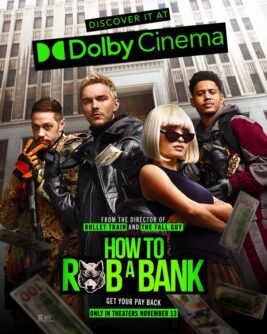
HOW TO ROB A BANK
An action-packed crime thriller that fights corruption with crime.
Should You Watch It?
Skip it. Despite its compelling story and thought-provoking themes about fighting injustice, excessive foul language, nudity, and violence overshadow the movie’s strengths.
I does offer an engaging look at how unfair, corrupt policies can burden society rather than help it, and at the lengths some people go to challenge the system. Through the protagonist and his friends, it explores frustration with institutional corruption and the desire to fight for people who have faced mistreatment.
However, their methods of seeking justice remain reckless and ultimately serve as a disservice to society. They rely on theft and violence, even using social media to expose corruption and rally anyone who has faced cheating by “the system” to take action. These choices shouldn't serve as admirable examples of advocacy.
Even so, the story raises some worthwhile questions: Are there truly policies in our world that prevent people from receiving the help they need? If so, what are some ethical ways to change them so they better serve those in need? This is strictly an adults-only viewing choice, and even mature audiences should think twice. The excessive foul language alone makes it hard to justify the price of admission.
The Story
NO SPOILERS — WE KEEP THE SURPRISESA small group of people use social media to discuss the challenges ordinary people face when trying to find good jobs, earn a decent living, and own a home. They also argue that a four-year college degree no longer guarantees a secure future. Along the way, they rob a bank and record the crime for their online followers, presenting it as an easier way to make money while demonstrating how to steal from a bank. In a sense, these individuals portray themselves as modern-day Robin Hoods. However, as their actions escalate, they must confront difficult questions: How far are they willing to go, and will their cause ultimately be worth the cost?
Is It Any Good?
Four stars. This movie presents a well-crafted, engaging story with a strong cast that brings its characters to life and gives audiences plenty to think about.
Beyond its entertaining premise, it raises interesting questions about the ethics of policies designed to serve the public and what happens when those systems fail. The story unfolds at a steady pace, builds suspense, and keeps viewers guessing about what might happen next.
The movie packs a punch with its foul language, violence, and other objectionable content. However, these elements don't completely overshadow the story's strengths. In fact, they help establish the upside-down world the characters inhabit and underscore the chaos surrounding their choices.
This doesn't excuse or endorse the objectionable material, but it recognizes its role in creating the movie's gritty atmosphere and driving home its larger themes. Even so, the negative content ultimately makes this one difficult to recommend.
The Worldview
This movie runs on humanist, romantic, anti-capitalist, and socialist elements. The protagonist and his friends feel like faceless numbers in a crowd. Each man carries a personal loss or fights to build a future for his family, yet the system overlooks them and treats them as less than human. The antagonist embodies that system. He shrugs at people in need and sees them only as a source of profit.
The anti-capitalist and socialist themes take center stage when the protagonist and his friends strike back. They turn to social media, expose the antagonist’s schemes, and rally ordinary people to grab what supposedly belongs to them through theft and violence. Their followers soon storm banks of their own, and the streets erupt into anarchy. The movie cheers them on and calls it justice.
A thin thread of biblical morality runs through the story, since the protagonist wants to expose real corruption. God hates injustice, and Scripture repeatedly condemns those who exploit the poor. However, the protagonist fights greed with greed and violence with violence. His guns, his heists, and his livestreamed beatdown of a CEO undo whatever good his cause might accomplish. He and his friends even mock a church service and rewrite the Ten Commandments into a guide for bank robbery.
In the end, the movie asks viewers to cheer for the very sin it claims to fight. The Bible offers a better path: “Better a little with righteousness than much gain with injustice” (Proverbs 16:8, NIV). True justice never comes through a stolen dollar.
The Content Guide
The specifics — spoilers included by nature — so you can judge for your own family.
Dominant Worldview and Other Worldview Content/Elements
Strong Humanist, Romantic, anti-capitalist, and socialist worldview in which characters are treated as less than human. The antagonist is indifferent to people in need and only looks for ways to exploit them. The protagonist and his friends respond to injustice with theft and violence, and they rally ordinary people who have been cheated by “the system” to steal and protest in the streets, to the point of anarchy. Light biblical, moral element exposing the corruption the antagonist orchestrates, but any good the protagonist does is overwhelmed by violence and theft. Anti-biblical elements, as the protagonist and his friends mock a church service and mock the Ten Commandments by teaching their own “10 commandments” for robbing banks. Light capitalist element where the antagonist, who looks for ways to make money off people in need, and a slight politically correct element appears briefly in a scene where a laptop is covered in politically correct stickers
Foul Language
Excessive foul laguage with 94 obscenities and profanities, including 87 obscenities and seven profanities, including 51 “f” words, two “mother f-” words, 18 “sh” words, two “piece of sh” phrases, two “bs” words, three “b” words, two “d” words, one “d-che b-g,” two “a-hole” words, three “S.O.B.” words, and one “d-k” word. The profanities include one “OMG,” three “GD” words, and three “holy sh” phrases
Violence
The protagonist and his friends enter a bank with assault weapons, hold people hostage, attack security guards, and steal money, and a van explodes outside the bank. Two groups of viewers start robbing banks and holding people hostage after learning from the main characters. The protagonist and his friends rob an armored vehicle by backing a truck up to it, using a Taser on one security officer, and taking a second officer hostage. A gun battle breaks out between the main characters and an off-duty police officer, followed by a high-speed chase in the armored vehicle. The robbers steal a car to evade police, and an officer crashes into a parked vehicle during the chase. The main characters hold an FBI agent and his assistant at gunpoint. A frustrated character shouts and slams his hands against a bathroom sink, then removes a hidden microphone from his body and burns it in a trash can. After being pulled over, a character draws a gun from his waistband and is shot by officers. Bank security officers help the main character reach the CEO’s office, where he pistol-whips the CEO several times and livestreams the assault while forcing him to confess to his financial schemes. Security guards then help the main character escape and attack FBI agents, and the main character fights an FBI agent in the bank’s parking garage. Anarchy breaks out in the streets near the bank among protesters who watched the livestreamed confession. Another FBI agent pursues and shoots the main character, who later crashes his car into a police car while trying to escape
Sex
A couple kisses and engages in intimacy while nude, but nothing explicit is shown
Nudity
The couple engaged in intimacy is nude, but nothing explicit is shown. One female character frequently wears short skirts or shirts that reveal her legs, a second wears very short shorts in her apartment in two scenes, and a third wears a short tank top that shows her midriff. Upper male nudity as man is shirtless while FBI agents fit him with a wire, and another male character is shirtless, covered by a blanket at the waist, while lying beside his wife. A group of women robs a bank wearing short skirts or shorts, and other women in short shirts are shown at the protest outside the bank
Alcohol Use
A male character drinks while driving
Smoking and/or Drug Use and Abuse
A female character smokes marijuana in her apartment, and a male character smokes a cigarette;
Miscellaneous Immorality
The protagonist and his friend use social media to teach people how to rob banks, escape, acquire weapons, evade capture, use fake bombs as diversions, and use a lawyer to avoid talking to police. They invite their audience to practice robbing banks with them and encourage bank security guards to steal from banks or help them do so. A female character admits to using a program she created to secretly track her ex-boyfriend, and one of the robbers hides his crimes from his family. The protagonist and his friends steal from banks but also donate money to charities. The group’s lawyer is shown giving the middle finger in a short video. A character backs out of helping the FBI catch the robbers, then later drinks while driving and gives police a fake ID at a checkpoint. The protagonist insists on robbing one final bank even after one of his friends is shot and killed by police. A bank CEO confesses to trapping people in need with unpayable debt for profit. An FBI agent nearly chokes the protagonist instead of arresting him after a fistfight, and the protagonist’s friends later help him escape prison.
Talk About It
Questions for the drive home, the dinner table, or the youth group.
How should Christians respond when they feel cheated by unfair wages or unreasonable taxes, and why does Jesus still call His followers to give what they owe, both to society and to God? Matthew 22:15-22
How do the Ten Commandments help us stay in a right relationship with both God and our neighbor, and what happens to a community when people make up their own rules instead? Exodus 20:1-20
What does Scripture teach about handling anger toward a neighbor, and how can we pursue peace and live to serve others rather than ourselves? Ephesians 4:25-32
How does Zacchaeus’s story show that no one stands beyond the reach of God’s mercy, and what does true repentance look like for someone who once exploited others? Luke 19:1-10
The Final Word
HOW TO ROB A BANK paints a vivid picture of a society crushed by corrupt policies and raises fair questions about greed and debt. However, the movie offers the wrong answer. It glorifies theft, violence, and anarchy, and it buries its message under heavy foul language, brutal gunfights, a nude sex scene, and mockery of the Ten Commandments. Real change comes through righteousness, not robbery. Skip it.