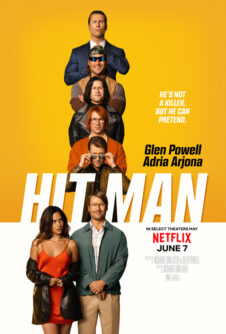
HIT MAN (2024)
A clever, funny premise curdles into a celebration of lies and murder.
Should You Watch It?
Here's the short version: a genuinely funny, well-built comic thriller talks itself into an ending Movieguide can't endorse — so skip it.
The first two acts have real pleasures. Glen Powell is charming as a mild professor moonlighting as a police department's fake hit man, the plot twists land, and the romance has energy. If the movie had stopped there, or resolved with some cost to its hero's dishonesty, this would be a very different review.
It doesn't. The film piles on more than 120 obscenities, two explicit-enough bedroom scenes, and then closes by rewarding its main character's deceit and lawbreaking with exactly the happy ending he wanted — no reckoning required. That's not a minor misstep; it's the whole point of the film's final act, and it's why an entertaining script ends up promoting something Movieguide can't wave through.
Skip it, and choose something else for the evening.
The Story
NO SPOILERS — WE KEEP THE SURPRISESGary Johnson is a mild-mannered professor who moonlights for the New Orleans Police Department — as a fake hit man. Different disguises, different personas, all designed to catch people looking to pay someone to kill an enemy. It's a good gig, until a client named Madison catches his eye. Posing as "Ron," Gary helps her get free of an abusive marriage — but Madison's husband has other plans, and he wants to hire Gary's hit man persona for a job of his own.
Is It Any Good?
Three stars means real craft with a serious asterisk. The first stretch of the film works: funny, well-paced, romantic, with plot twists that genuinely engage. Richard Linklater and Glen Powell (who co-wrote the script) build a likable hero and a story that, for a while, drifts toward the sly menace of a film noir like Body Heat.
Then it swerves. The tone shifts serious, the noir instincts the film had been building evaporate, and the ending arrives feeling eccentric and unearned rather than satisfying. A script this entertaining, with a hero this interesting, deserved a resolution that didn't ask the audience to cheer for lawbreaking and deceit. The talent on screen is real. The choice at the finish line squanders it.
The Worldview
Hit Man runs on a strong Romantic, antinomian worldview — one where two heinous crimes go unpunished and the hero, a teacher of philosophy and psychology, ends his arc by telling his students "there are no moral absolutes," urging them instead to invent their own identity and destiny. That claim collapses on itself: to say there are no moral absolutes is itself an absolute claim, denying and asserting moral truth in the same breath.
There are better threads here, even if the film doesn't follow them to their conclusion. Gary's police work protects a woman from real danger; his bosses are portrayed as good cops doing good work; justice, for a while, looks real. The film also includes LGBT content worth flagging for families: a visible transgender flag and a pride flag outside a New Orleans bar, plus a scene where a policeman comically agrees he'd rather be with his colleague's charismatic undercover persona than her boring real self.
What the film ultimately can't shake is its ending's verdict: that lying your way into the life you want is a fair trade, so long as it works out. Scripture disagrees. "There is a way that seems right to a man, but its end is the way to death" (Proverbs 14:12). A happy ending built on deceit isn't the same thing as a good one.
The Content Guide
The specifics — spoilers included by nature — so you can judge for your own family.
Dominant Worldview and Other Worldview Content/Elements
Strong Romantic, antinomian worldview where people get away with two heinous crimes, and the title character is a teacher who discusses morality, psychology and philosophy with students in several scenes but concludes at the end that “there are no moral absolutes” and advises his students to create their own identity and choose their own destiny (of course, to say there are no moral absolutes is self-contradictory and therefore false because it affirms its own moral absolute while at the same time it denies that moral absolutes exist), with some light moral elements in story about a police consultant who protects a woman at all costs and who brings criminals to justice through his work with the New Orleans Police Department, plus the hero’s police bosses are seen as good cops, and there are some LGBT elements where there’s a visible transgender flag, an LGBTQ pride flag outside a bar in New Orleans and a heterosexual policeman comically agrees with his female boss he’d rather make love to a policeman’s charismatic undercover persona than his boring real-life persona
Foul Language
At least, 125 obscenities (including about 79 “f” words and 24 “s” words), one profanity mentioning Jesus, one GD profanity, and three light profanities
Violence
A scene where a passed out character is suffocated to death with a bag is a bit strong, but the rest of the violence is rather light and includes a woman pulls out a gun and waves it \, a man pulls a gun on woman’s estranged husband who seems about to get violent, one mention of rape, references to suicide in two scenes, references to a character being shot dead off screen, and references to murder and to police and police consultant working together to arrest people trying to hire a hit man who happens to be an undercover plainclothes police officer
Sex
Partially depicted fornication in once scene with unmarried lying in bed afterwards, implied fornication with passionate kissing in another bedroom scene, couple lays in bathtub together with man’s upper nude torso showing in one scene, passionate kissing in another scene, dialogue insinuate two people want to fornicate, partial and a mention of rape
Nudity
Partial upper female nudity in two scenes from the side and some images of upper male nudity, including scene where unmarried couple are lying in bathtub
Alcohol Use
Man and woman are seen drinking at a bar, and three people drink a beer together
Smoking and/or Drug Use and Abuse
One scene where man and woman share a cigarette, and three verbal references to drugs, including character says she drugged another person;
Miscellaneous Immorality
Lying and deception.
Talk About It
Questions for the drive home, the dinner table, or the youth group.
The professor at the center of this story tells his students, "There are no moral absolutes." Why does that statement contradict itself, and what does Scripture say about where moral truth comes from?
Romans 2:14–15 · Psalm 19:7–9Gary builds a relationship on a lie about who he really is. What does the Bible say about truthfulness in our closest relationships?
Ephesians 4:25 · Proverbs 12:22This story ends with its hero finding the life he wants by breaking the law and deceiving everyone around him. Does a good outcome ever justify how you got there?
Proverbs 14:12 · Romans 3:8Madison is trying to escape an abusive marriage. How can Christians support someone fleeing abuse without excusing sin against the abuser in return?
Psalm 34:17–18 · Romans 12:19The Final Word
There's a genuinely good movie buried in the first two-thirds of Hit Man — funny, romantic, well-built. But a story is judged by where it lands, and this one lands by rewarding lies and lawlessness with a happy ending. Our answer stands: skip it. Looking for something to watch instead? Start here:.