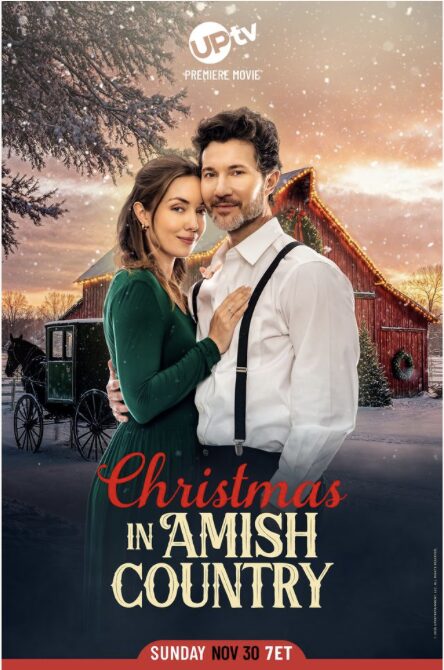
CHRISTMAS AT AN AMISH BAKERY
A warm Kentucky Christmas where family — and faith — win.
Should You Watch It?
Here's the good news up front: this is a Christmas movie you can put on with the whole family and simply enjoy. It's a UPtv holiday romance with a strong Christian, pro-family heart — one that promotes worship, prayer, hope, forgiveness, and love without apology, and even lets a children's choir sing openly about the birth of Jesus.
Is it flawless? No. The dialogue can be stilted, and the story turns a little passive in places. But it more than makes up for that with heartwarming, cute scenes and some genuinely funny ones — the kind of gentle, cozy holiday film that leaves you feeling better than when you sat down.
So if you're gathering the family for a Christmas movie night and want something clean, warm, and quietly rooted in faith, this one's an easy yes.
The Story
NO SPOILERS — WE KEEP THE SURPRISESSarah is a cookbook editor in Chicago, and sales are slumping badly enough to threaten her job. Her boss, Darla, spots a Christmas card on Sarah's desk — from her sister Rachel, who runs a small Amish bakery in Kentucky — and sends Sarah home to gather authentic family recipes for a new Amish cookbook.
Sarah is glad to be back with her Amish family for the first time in years. But she's surprised to find a non-Amish widower named Dean, and his adorable young daughter, helping out on her father's farm. And she's finding it awfully hard to bring up the real reason she came home.
Is It Any Good?
Three stars, and here's what they mean. This won't win awards, but it delivers exactly what it promises. The dialogue is sometimes stilted and the plot drifts a bit passively in spots — yet the film keeps winning you back with warmth and charm.
The best moments are the small ones. There's a lovely scene where Dean teaches Sarah's new-father brother-in-law how to quiet a crying baby. And Dean's precocious, adorable daughter Zoey — played by Emma Henderson, who has a genuinely appealing onscreen presence — steals scenes as she interacts with the other characters, including Sarah's kind, quiet father. It's these charming, heartfelt touches that lift the movie above its rough edges.
The Worldview
This is a film with a very strong Christian, pro-family worldview, and it wears its faith warmly rather than as decoration. It promotes family, worship, prayer, hope, forgiveness, and love — and it means them.
The faith isn't kept vague, either. The children's choir practices and performs real Christmas carols about the incarnation, singing "Come, Let Us Adore Him" and "Silent Night." The beginning of a prayer to the Father is heard. Matthew 11:29 appears inscribed on a sign inside a house. A Nativity display is referenced twice. And an Amish woman's gentle observation that "perfection challenges God" carries a quietly biblical truth: human mistakes are inevitable, but they can be repented of and forgiven.
Running under the romance is the film's deepest note — home and belonging. Sarah's Amish father tells her she is always welcome back home, no matter where she roams. It's a small line, but it echoes something eternal: a Father whose door is always open to the one who comes back. "While he was still a long way off, his father saw him and felt compassion, and ran and embraced him" (Luke 15:20).
The Content Guide
The specifics — spoilers included by nature — so you can judge for your own family.
Dominant Worldview and Other Worldview Content/Elements
Very strong Christian worldview with very strong moral, pro-family elements promotes family, worship, prayer, hope, forgiveness, and love and includes children practicing for a Christmas festival concert sing the first two verses from the Christmas carol “Come let us adore him, born the king of angels” in preparation and sing “Silent Night” at the festival that’s held by an Amish community, the beginning of a prayer to the Father is heard, Matthew 11:29 is shown in an inscription on a sign inside a house, an Amish woman says, “Perfection challenges God” and implies human mistakes are inevitable and can be repented and forgiven if necessary, two references to a Nativity display, and heroine’s father tells her she’s always welcome back home
Foul Language
No foul language
Violence
Angry side character smashes a candy cane on a counter when she can’t reach her employee on the phone, and a deadly traffic accident is related
Sex
No sex
Nudity
No nudity
Alcohol Use
No alcohol use
Smoking and/or Drug Use and Abuse
No smoking or drugs;
Miscellaneous Immorality
Lying but rebuked in a quiet but strong way.
Talk About It
Questions for the drive home, the dinner table, or the youth group.
Sarah struggles to be honest with her family about why she really came home. How does the film show that lying — even for good reasons — needs to be brought into the light?
Ephesians 4:25 · Proverbs 12:22An Amish woman says "perfection challenges God," reminding us that mistakes are inevitable but can be forgiven. Where do you need to receive — or offer — that kind of forgiveness this Christmas?
Colossians 3:13 · 1 John 1:9Sarah's father tells her she's always welcome back home, no matter where she roams. How does that welcome picture the way God receives us when we return to Him?
Luke 15:20–24The children's choir sings openly about the birth of Jesus. Why does the movie make the "reason for the season" so central, and how can your family keep it central too?
Luke 2:10–11 · John 1:14The Final Word
This is a cozy, faith-filled Christmas romance with a big heart and a clear love for family and God. It's not perfect filmmaking, but it's warm, clean, and genuinely sweet — the kind of movie made for a December evening on the couch together. Our answer is the same one we started with: worth the trip.