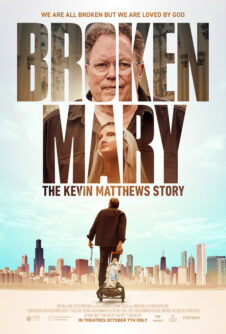
BROKEN MARY: THE KEVIN MATTHEWS STORY
A shock-jock's shattered life, remade by grace — worth your family's time.
Should You Watch It?
Yes — and this is an easy one. Kevin Matthews spent a decade as one of Chicago radio's biggest names, reaching ten million listeners a week, before a Multiple Sclerosis diagnosis cost him his career and sent his life into a spiral. What follows is a documentary about what God did with the wreckage.
There's no hidden cost here for families. The film discusses Kevin's earlier drinking, drug use, and destructive behavior in plain but non-graphic terms, and it treats all of it as sin to be repented of, not celebrated. What remains on screen is a testimony — clear, moving, and centered on the Gospel.
If your family wants a true story about brokenness meeting grace, this is worth the trip.
The Story
NO SPOILERS — WE KEEP THE SURPRISESKevin Matthews grew up in a hard home with an abusive father, and learned early to survive by being funny and mean. That same wit carried him from a college radio station into a job at one of Chicago's biggest stations, where his show climbed to ten million listeners a week and made him a local legend. He used his platform for philanthropy, too — though his generosity had a self-destructive streak that kept undercutting it.
Then his body betrayed him. A sudden paralysis, a diagnosis of Multiple Sclerosis, and the career that had defined him was gone. What Kevin did with that loss — and who met him in it — is the rest of the story.
Is It Any Good?
Three stars means this documentary does its job well without reinventing the form. The source material praises it as "engaging" and "inspiring," and singles out how effectively it captures the contrast between Kevin's "before" and "after" — the self-centered radio star and the humble believer he became. That before-and-after structure is the film's clearest strength: it lets the transformation speak for itself rather than over-explaining it.
This isn't flashy filmmaking, and it doesn't try to be. It's a testimony documentary that trusts its subject's honesty about his own failures, and trusts the Gospel to do the rest. For what it sets out to do, it succeeds.
The Worldview
This is a documentary built entirely around one conviction: that Jesus Christ can take a broken life and remake it, no matter how far gone that life was. The film comes from a Roman Catholic Christian perspective, and it wears that faith openly — Kevin's testimony is unapologetically about the Gospel, not a generic self-help arc. He names his old life as sin, not just as a "bad phase," and he credits his transformation entirely to Christ rather than to willpower or therapy.
The film's central image does the theological work for it: a broken statue of the Virgin Mary that Kevin encounters in a parking lot, in which he sees his own brokenness — and the possibility that broken things can still be used by God. That symbol, and the "Broken Mary Project" it inspired, frames the whole story as one of redemption offered freely, to anyone, regardless of what they've done.
There's nothing here to correct doctrinally in the sense of content Movieguide flags — the film is notably restrained about depicting the sins it discusses, choosing to name them and move toward repentance rather than dwell on them. The result is a worldview squarely aligned with Scripture's own logic: that God is near to those the world has discarded. "The LORD is near to the brokenhearted and saves the crushed in spirit" (Psalm 34:18).
The Content Guide
The specifics — spoilers included by nature — so you can judge for your own family.
Dominant Worldview and Other Worldview Content/Elements
Very strong Christian, biblical, moral worldview from a Roman Catholic Christian perspective in a documentary as man shares what his faith has meant to him (though he used to live a very self-centered, hedonistic life, he has since turned things around and now lives fully for the Lord), man talks extensively about how his faith has redeemed his life and turned him from a broken man into someone who is whole, man now shares the Gospel across the country, using his testimony to connect with others who feel helpless, a broken statue of the Virgin Mary inspires the movie’s title character
Foul Language
No foul language, though a handful of epithets are bleeped
Violence
References to Kevin’s dad beating him and his mother
Sex
No sex
Nudity
No nudity
Alcohol Use
Kevin refers to heavy drinking earlier in his life
Smoking and/or Drug Use and Abuse
Kevin makes references to smoking and doing drugs when he was younger;
Miscellaneous Immorality
Some references to heavy partying, destruction of property, stealing, and arson, but rebuked.
Talk About It
Questions for the drive home, the dinner table, or the youth group.
Kevin says his brokenness was the very place God met him. Where in your own life have you seen God show up most clearly in weakness rather than strength?
Psalm 34:18 · 2 Corinthians 12:9–10The film credits Kevin's whole transformation to Jesus Christ, not to willpower. What's the difference between changing yourself and being changed by God?
2 Corinthians 5:17 · Ephesians 2:8–9Kevin used comedy as a shield against a painful childhood for years before he ever dealt with the pain itself. Are there ways you've learned to cover pain instead of bringing it to God?
Psalm 51:17 · Matthew 11:28The broken statue of Mary became a picture of Kevin's own life. Why do you think broken, ordinary things so often become the images God uses to teach us?
1 Corinthians 1:27–29The Final Word
Kevin Matthews spent a career being funny for a living and years being broken in private — and then found, in a parking lot and a battered statue, a picture of exactly what grace does with wreckage. This is a small, honest, well-made testimony, and it earns its place on family movie night. Our verdict stands: worth the trip — older children and adults.