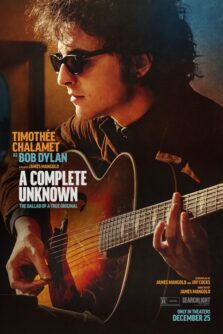
A COMPLETE UNKNOWN (2024)
Great songs, fine performances — and history it can't be trusted with.
Should You Watch It?
Here's the honest tension. Musically, this is a real thing — great songs, fine performances, and a genuine window into the power Bob Dylan's music had on folk and pop culture. On the strength of the music alone, you can see why people love it.
But the movie earns its −3, and that's where we land. It carries about 33 obscenities, including roughly 17 "f" words, plus several profanities that take the name of Jesus Christ. It stages implied fornication and an unmarried couple living together. And it doesn't just entertain — it rewrites. The film soft-pedals the communist roots of Pete Seeger, Joan Baez, and the whole folk revival, and distorts one biographical fact after another, right down to what actually happened at the 1965 Newport Folk Festival.
So here's the answer: skip it. The music may be beautiful, but the film wraps it in language, sexuality, and revisionist history a discerning viewer shouldn't pay to absorb.
The Story
NO SPOILERS — WE KEEP THE SURPRISESNew York, the early 1960s. A young unknown named Bob Dylan (Timothée Chalamet) arrives with a guitar and an ear for something new, and walks straight into the folk revival led by Pete Seeger and Joan Baez.
What follows is a heady rise — fame, adoration, a young activist girlfriend urging him toward protest songs, and a growing reputation as a detached, sunglasses-and-motorcycle celebrity. It all builds toward one controversial night at the 1965 Newport Folk Festival, where Dylan plugs in an electric guitar and divides a room. Whether that's triumph or betrayal is the question the movie is chasing.
Is It Any Good?
Three stars, and they belong almost entirely to the music and the cast. The songs are great, the performances are fine, and as an introduction to the sound and cultural weight of Dylan's early career, the film genuinely delivers. There's real profundity and artistic beauty in the Dylan music it puts on screen.
Where it falls short is honesty. The film distorts too many biographical facts to count as a reliable portrait — from the circumstances of Dylan's arrival in New York, to when he met Seeger, to the timeline of his relationships, to the actual events of the 1965 festival. It even invents a moment of Johnny Cash advising Dylan at a festival Cash didn't attend. The result is an entertaining but somewhat superficial sketch — good music in service of a story that keeps bending the truth.
The Worldview
At heart this is a Romantic, iconoclastic film about art, society, politics, and individual self-expression — the lone artist against the crowd. Some of that instinct is admirable, and the movie does show people wrestling with moral decisions, however confused. A few folk concerts even unfold inside churches.
But the film's governing sin is what it hides. The real history of the folk revival — the communist leanings of figures like Woody Guthrie and Pete Seeger — is quietly scrubbed. Seeger played down his Communist Party membership late in life, yet throughout his career he promoted and associated with communist and Soviet front groups. The movie stages a courtroom scene around Guthrie's "This Land Is Your Land" but omits that the song was written against Irving Berlin's "God Bless America" and once carried overtly anti-American verses. The film raises political questions and then conveniently forgets them — all while diligently celebrating the impact of Dylan's own protest music. That selective memory is the worldview problem here: revisionist history dressed as nostalgia.
The film also makes Dylan out to be more of a jerk than he arguably was, and it changes and fictionalizes the story of his real-life girlfriend at his request — including erasing painful details of that relationship.
Underneath the restless self-invention runs a hunger for something that lasts — the very thing a life of fame and reinvention can't provide. "The grass withers, the flower fades, but the word of our God will stand forever" (Isaiah 40:8).
The Content Guide
The specifics — spoilers included by nature — so you can judge for your own family.
Dominant Worldview and Other Worldview Content/Elements
Strong Romantic, somewhat iconoclastic worldview about art, society, politics, culture, lifestyle, and individual expression, with some politically correct revisionist history that whitewashes the communist background to major folk music artists and counter-culture figures of the 1930s to 1960s, plus a few folk concerts are set in churches, and people show a concern for making moral decisions, though they are often confused
Foul Language
About 33 obscenities (including about 17 “f” words), four strong profanities mentioning the names of Jesus Christ, one GD profanity, and one OG profanity
Violence
Brief violence such as a fight breaks out during a controversial concert, where people also throw some soda cans at artists, and a man is punched in another scene
Sex
Two scenes of implied fornication, plus an unmarried couple lives together (the name of the real-life young woman is changed), and there’s some passionate kissing
Nudity
Two scenes with upper male nudity
Alcohol Use
Some alcohol use
Smoking and/or Drug Use and Abuse
Cigarette smoking and brief scenes of implied marijuana smoking;
Miscellaneous Immorality
Major character is sometimes rude and detached and seems to let his well-earned fame go to his head.
Talk About It
Questions for the drive home, the dinner table, or the youth group.
The film celebrates the lone artist reinventing himself over and over. Where's the line between healthy growth and simply refusing to be pinned down — and what does Scripture say our identity is finally anchored to?
2 Corinthians 5:17 · Galatians 2:20Movieguide argues the movie rewrites history to hide uncomfortable truths. Why does honesty about the past matter, and what does it cost when we bend facts to fit a story we prefer?
Proverbs 12:22 · Ephesians 4:25Fame changes the Dylan of this film — he grows rude and detached. How does success tempt anyone toward pride, and how does Scripture describe the safer road?
Proverbs 16:18 · Philippians 2:3–4Dylan's protest songs stirred real movements for justice. What's the biblical vision of justice, and how does it differ from a purely political one?
Micah 6:8 · Isaiah 1:17The Final Word
The music is genuinely great and the performances are fine — but that's not the whole picture. This is an R-rated portrait thick with profanity and promiscuity, and it quietly launders the politics behind the story it tells. So our answer holds: skip it. Looking for something the whole family can enjoy instead? Try our latest family-friendly picks.